Thanks go to Jack who left this comment in a previous post.
Thomas Merton was also for me an introduction to spirituality. At university, my creative writing teacher introduced me to him and then as I wrote she told me that my writing reminded her of the “Zen” poets from China and Japan and contemporaries such as Gary Snyder. I started to read them, found an ad for Shasta Abbey Buddhist Supplies, ordered a statue and received info from the Abbey and a few months later when I was eighteen I took the Greyhound bus from Denver to Shasta. A moment that changed my life and just now I can feel the gratitude in my heart to this professor who really took me under her wing in my young days. Interestingly, she was an ex-catholic nun. Thank you, Rita, for pointing me in the Way. If you are interested here is a bit about Rita Brady Kiefer.
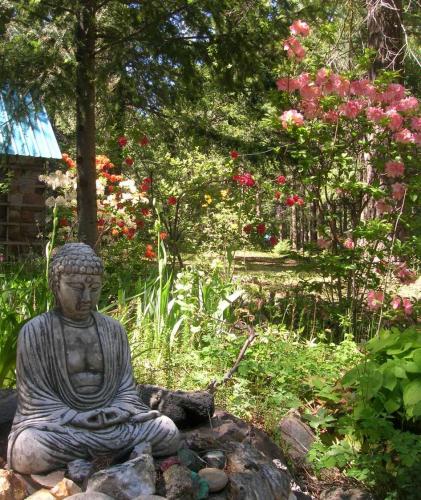
Amida Buddha sitting still in the garden
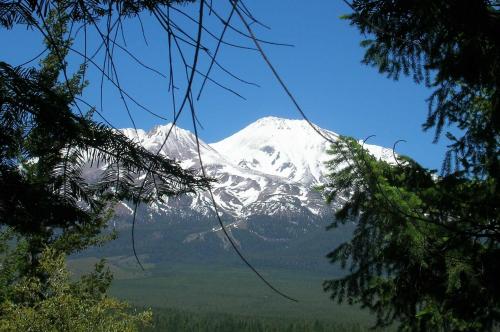
Mt. Shasta as seen from the monastery grounds
Jacks comment, left on the previous posting, reminded me of several people who entered my young life and for whom I too have great gratitude. Tonight I’m thinking particularly of an aunt who encouraged me to write after she read letters I’d sent to my parents describing my travels in America in 1967.
It would appear that Rita Kiefer is still encouraging people to express themselves through writing.
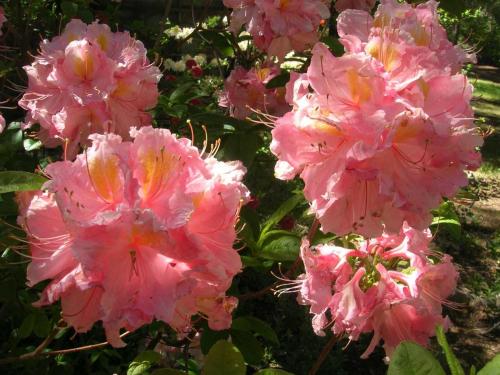
Looking into the faces of these flowers this afternoon I found myself smiling. So too when looking into the faces of people in bloom.
This evening we watched a DVD about The Abbey of Gethsemani the Trappist monastery in Kentucky where Thomas Merton lived during the latter part of his life. The Abbey has a classic URL: http://www.monks.org/. A contemplative order they may be, out of touch with the world they are not.
We are so obsessed with doing that we have no time and no imagination left for being. As a result, men (and women) are valued not for what they are but for what they do or what they have – for their usefulness.
Thomas Merton
A modern day Zen monk is remembered for say that Zazen is ‘good for nothing’!
Here’s more on Thomas Merton for your interest and information.
The abbot (of Gethsemani also) urged the young monk (Thomas Merton) to write his autobiography, which was published under the title The Seven Storey Mountain (1948) and became a best-seller and a classic. During the next 20 years, Merton wrote prolifically on a vast range of topics, including the contemplative life, prayer, and religious biographies. His writings would later take up controversial issues (e.g., social problems and Christian responsibility: race relations, violence, nuclear war, and economic injustice) and a developing ecumenical concern. He was one of the first Catholics to commend the great religions of the East to Roman Catholic Christians in the West.
For some years Gethsemani has hosted conferences under the banner Inter-religious Dialogue when Buddhist and Christian Monastics join to debate. This years meeting which ended a couple of days ago was titled Monasticism and the Environment.
Links to the works of Thomas Merton on-line.
Within these Precepts dwell the Buddhas, enfolding all things within their unparalleled wisdom: There is no distinction between subject and object for any who dwell herein.
All things, earth, trees, wooden posts, bricks and stones, become Buddhas once this refuge is taken. From these Precepts come forth such a wind and fire that all are driven into enlightenment when the flames are fanned by the Buddha’s influence: this is the merit of non-action and non-seeking; the awakening to True Wisdom.
Shushogi: What is Truly Meant by Training and Enlightenment – Zen Master Dogen.
Last week when I was on the bus traveling up to Shasta Abbey from the Bay Area I listened to the Shushogi sung by the monks at Throssel on my small mp3 player. The above quote is very familiar since, as a novice, I read it every day along with the Kyojukaimon – (Giving and Receiving the Precepts.) From time to time I’d ponder about what the Buddha’s influence actually is, eventually such thoughts faded away. My monastic colleague has just said, You have to be willing not to need to define what the influence is.
My attention has been drawn to the Breast Cancer Fund Climb Against the Odds expedition to the top of Mt. Shasta in June this year.
At 14,162 feet, Mt. Shasta stands as the most striking mountain in Northern California and is home to California’s largest glaciers. Besides training for the peak attempt, climbers commit to raising a minimum of $5,000 for the Breast Cancer Fund’s work to prevent the disease. We provide the support to achieve both.
The Breast Cancer Fund identifies – and advocates for elimination of – the environmental and other preventable causes of the disease.
When I was a novice at Shasta Abbey in the early 1980’s I was with my ordination sister Goso in the bath-house, where speaking is strictly forbidden. Looking up at the mountain through the window she whispered, We’ll climb that one day. Sadly she didn’t live long enough for us to do that. She died in November 1986, of breast cancer.
A small girl of five was playing on some boulders during a walk in the wilderness. One came loose under her. She and the bolder rolled down a hill. When she and the 100 pound boulder came to a stop it was on top of her. The emergency services came quickly and she was set free.
The girl is now at home in a full body caste. She will be laying supine for six weeks, at least. Soon after the accident a family friend instructed her on breathing techniques to help her deal with the pain. Oh! she responded confidently, as soon as the boulder was on top of me I knew I couldn’t fight pain!
That’s a realization many take years, of painful experience, to come to. And many more years to practice that understanding.
Hang in there Miranda and remember what you know.
Practice Within The Order of Buddhist Contemplatives