Within and Beyond Opposites

This first verse from the *Shushogi just keeps coming into my mind this evening. Here it is:

Shushogi
Introduction (The Reason for Training).
The most important question for all Buddhists is how to understand birth and death completely for then, should you be able to find the Buddha within birth and death, they both vanish. All you have to do is realise that birth and death, as such, should not be avoided and they will cease to exist for then, if you can understand that birth and death are Nirvana itself, there is not only no necessity to avoid them but also nothing to search for that is called Nirvana. The understanding of the above breaks the chains that bind one to birth and death therefore this problem, which is the greatest in all Buddhism, must be completely understood.

….how to understand birth and death completely, you could say understand life and death. This is a huge question isn’t it.

It is common to fear death. We are alive on this planet and there is a lot of livin’ to do and even though future life is unknown at least one knows eventually one will know! When the light goes out on life we are in the dark! And we don’t ever know when that will be. But this is no way to live is it. That’s locked into time going from the white light of youth, through the misty middle days to the advancing dusk. Then night.

How about actively choosing life as a way to go? To be fully present, not swinging between half-asleep or over-awake to the detriment? Perhaps this is the how to of the understanding of life (birth) and death Zen Master Dogen is urging us to get to grips with. Simply put, to simply live within and beyond the opposites, all opposites.

*The Shushogi is a compilation of Great Master Dogen’s ideas, put together by the Soto Zen school in Japan early in the last century. It was created as an introduction to Dogen and as a means of communicating ideas fundamental to Soto Zen practice. The whole of the Shushogi can be found on the Order’s website.
Judgmentalism – Not a Sport to Pursue

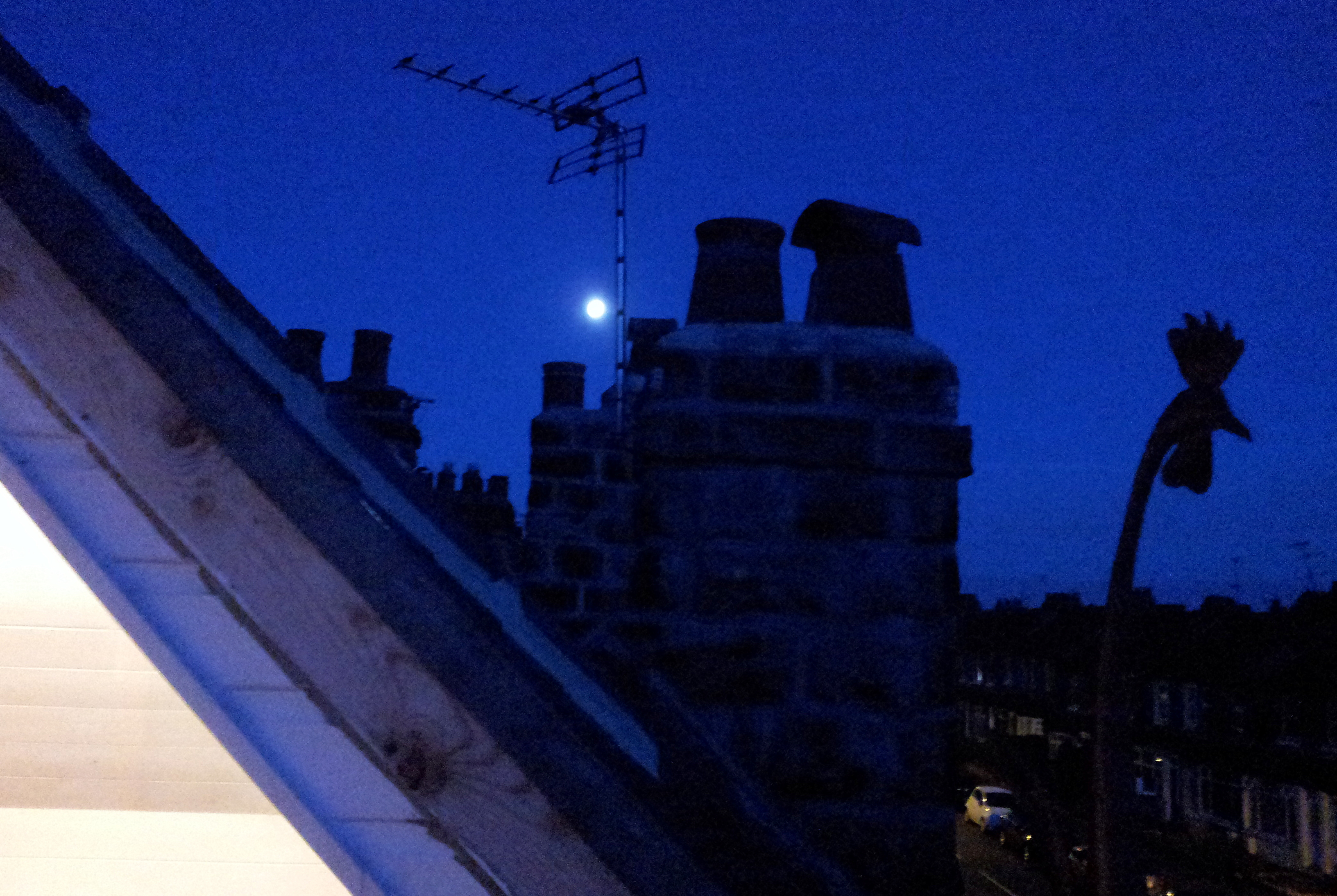
The moon from a roof terrace, Harrogate Yorkshire.

The following is a quote from a comment left some time ago now. I’ve been sitting with what to say in answer especially as the book referenced in the comment left me…not hanging in uncertainty as the write says of herself below, just a tad perplexed.

Recently I’ve been reading material that deals with the realization of our desires, and have been trying to reconcile it with the Buddhist position of no desire, and I guess I could say that I’m hanging in uncertainty! I think that one can only live in the present, and that breathing and accepting what one is experiencing in that moment (even though you “want” more) is the only way to live. I’ve come a long way in coming to this understanding…..(here follows a quote from a book)

Frankly I don’t visit the spiritual section or self help section or even the religious/Buddhist section in bookstores and only very rarely visit on-line stores. So my perplexedness is now realizing there is a whole huge world of material out there about getting what one wants, or the realization of our desires which seems to have gone to a whole new level! Frankly, and I know this is an unpopular thought, I’d say it is best to walk past, walk outside and take some sunshine in a nearby park instead of leafing through books such as these.

And yet, and perhaps, it is through such material people come to practice in a faith tradition or take their spiritual understanding deeper as the writer above has done and says as much too. I’ve come a long way in coming to this understanding….(spiritual understanding), and I know she has. And if I cast my mind back pre-monasticism, and am honest, I too read widely in search of answers to the big questions. Perhaps it was part of refining what it was that I REALLY wanted. Then found it, not in a book!

As for the subject of desire in Buddhist teaching. Suffering, the first of the Four Nobel Truths is caused primarily, but not exclusively, by tanha which is translated as thirst, desire or craving. As long as we are flesh and blood and however enlightened we might be, desire will arise. It is the thirsting after that which we desire (even holy matters) which is the continuation of suffering. The sad thing is that however much we get what we desire it is never enough. There are always more subtle desires, or not so subtle ones to pursue. Endlessly. Wanting is a wily beast! As the thirsting after is seen, and seen for what it is, yes indeed ones desires/needs/wants become fewer and perhaps more basic to survival. But self judgment and judgment of others around the subject of, the level of and the content of desire is a sport best let go of very quickly indeed! And constantly.

Last evening I enjoyed a lovely evening meal on, or in, a tiny roof terrace hosted by a sangha member and his wife. As the evening wore on the light dimmed to navy and the moon popped over the roof tops asking to be recorded. Thank you both so very much.

Seeing – Looking

The Art of Looking, a book reviewed extensively in Brain Pickings might at first glance appear a bit off topic in terms of Buddhist practice. However read on, take a look! There is talk of presence and paying attention and noticing. Although I have not had a chance to read all of the article quite yet what I have read resonates.

One of our senior monks will talk about perception from time to time. Our ears know how to hear, our eyes know how to see. What is needed is to loosen our tendency to go out there hunting. Indeed, more and more I am realizing one need not go out there seeking with ones eyes or ears or any of the other senses – what is there comes in!