All posts by Mugo

Koho Zenji’s Temple, Raigakuji

Raigakuji is a temple about two miles north of Chino in Nagano Prefecture. The site is on a hillside looking westwards towards the higher peaks of central Japan. From the top of the hill, on a clear day, you can see Mt. Fuji far to the south.

Keido Chisan Koho Zenji was the 32nd abbot here, and from many of the things we were told about the temple it was clearly a place he loved very much and which he had strong personal and family ties with (towards the end of her life his mother lived here). When he was first associated with Raigakuji he was responsible for raising funds for a new ceremony hall for the temple to replace one that had been destroyed by fire, and we saw photos of him and people from the local community with this work in progress. In a place of honour on the ceremony hall wall is a big oil painting of him in later life.

The meditation hall at Raigakuji is reached by a staircase leading up the hillside.
By Iain.

Outside of the main hall.

Keizan Zenji’s Temple, Yokoji.

Yokoji was perhaps our most important ‘discovery’ in researching this visit. In the short biography of Keido Chisan Koho Zenji in the Shasta Press edition of ‘Soto Zen,’ it is called by an alternative name of ‘Eiko-ji’ so we were a little slow to realise just how important this temple was to our direct Dharma Family.

Yokoji is the temple where Keido Chisan was ordained by Koho Hakugan and trained as a young monk in the 1890’s. He was later the 512th abbot of the temple. It is located in the hills behind the small town of Hakui halfway up the west coast of Noto – the peninsula that sticks out northwards into the sea of Japan about halfway along the coast of the main island of Honshu. This is the original heartland of Soto Zen practice in Japan.

Yokoji is also a very important place in the wider transmission of the Soto tradition. We usually think of Sojiji as being Keizan’s most important temple but actually Yokoji was his main place of practice during his own lifetime – the first he established in 1312 and also where he is buried.

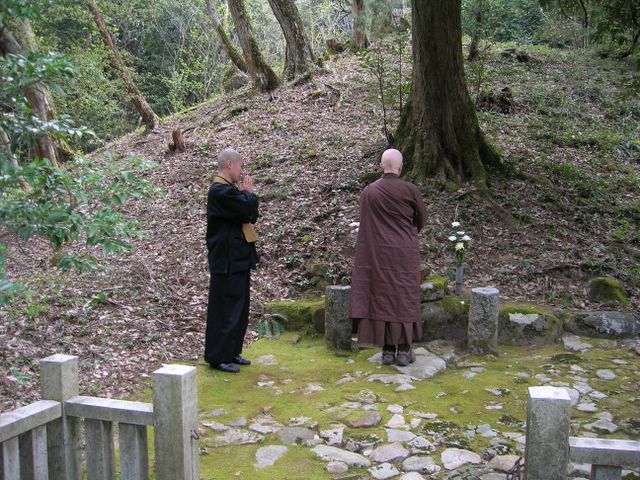
There is also a unique place of pilgrimage at Yokoji – the Gohoro. This is a mound on the hillside behind the temple containing relics associated with five Ancestors in our tradition – Tendo Nyojo, Eihei Dogen, Koun Ejo, Tettsu Gikai and Keizan Jokin.

Only the gatehouse survives of Keizan’s original buildings but the plan of the temple follows the classic form of the original with the Hatto directly ahead as you pass through the entrance and the meditation hall and bell tower to the left and administrative buildings and kitchen to the right.
By Iain.

Mr Gouda in the back row is in charge of the temple office. The five people here basically run and maintain the temple, Rev. Koho lives in a nearby town and comes to the temple each day.