An Oblation to the Absolute

There is another kind of spiritual courage as well, quieter and less celebrated, but just as remarkable: that of making each day, in its most conventional aspects — cooking, eating, breathing — an oblation to the absolute.
— Philip Zaleski, From a New York Times book review. July 24, 1994.

Sorry, I can’t track down the actual review.

Years ago in the mid 1980’s I wrote a Journal article titled, To Proffer Abundant Oblations. I loved that word oblations, wonderfully expansive and all embracing.
Here is the definition of this phrase at the start of the article:

To offer for acceptance that which is intangible, in ample sufficiency, in thanksgiving to the Eternal Buddha.

Vicarious Adventure

The group of cyclist riding south from Watson Lake to Yellowstone just posted news of their first nine days on the road. Reading it I’m transported to days past when I’d take off on long bike rides, rides before monastic life. Riding in Ireland in the rain, peddling up hills to the sometimes fast, often slow, rhythm of the Can Can. Dah, da, da, da, da, dah, dah da, da, da, da,…. My how it can rain in Ireland; and on the road south from Watson Lake by all accounts.

Monday August 25th
Rain thru the night and into the morning. We lie in our tents waiting to see who will be the first to make a move. We rally around 9:30 AM. Cook up the rest of our oatmeal which is around six bites per person and heavily supplemented by spoonfuls of peanut butter. The dirt road we came to our campsite is now a mudslide puddle mixture so we push our bikes through the woods and up the steep embankment to the road. The rain subsides and we are back on the road. We make good time into Fort Nelson. The forestlands give way to cleared pastures affording us magnificent views of the country. To the West we can see snow capped peaks of the coastal ranges. We spot the old remains of a blackbear road kill.
Great photos too.

This post is offered in memory of Cuthbert who, in his early years in Montana, would pick up road kill and bury it. He was known as ‘the man who picks up animals’. Later he was killed in New York. A truck ran over him, and his bike, at a crossing. After that I sold the priory bicycle and didn’t climb aboard one for well over ten years. Taking a short ride to break the biking fast seemed like a good thing to do at the time. My serious biking days are over though.

Good fortune to the riders in the wilds.

Errr! 11.30 p.m. That sounds like the Racoons out in the garden again, pulling up the lawn and washing their spoils in the fountain. Wild life in Berkeley. Bless em.
Change of Direction

Muchie_cat.jpg
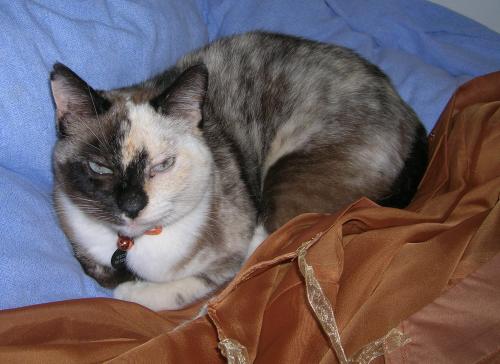
Muchie, blue eyed priory cat with robe.

Fancy cat, fancy ceremonial robe. Those golden ties so tempting. Briefly a paw flexes to pounce as I pick up the robe before the ceremony yesterday morning. Poised. The paw twitches again and…. No! Paw washing next. I’m not sure I can attribute this change to a deliberate decision on her part, non the less, I’m grateful she chose washing over pouncing.

A recent visitor reminded me of a helpful telephone conversation he had with one of the monks. He and his wife were caught between going to a retreat or standing by at their home to offer help to a small monastic community should the threatening forest fire come close enough to require evacuation.

Continue on with the original plan, while at the same time be prepared to change direction at any moment.

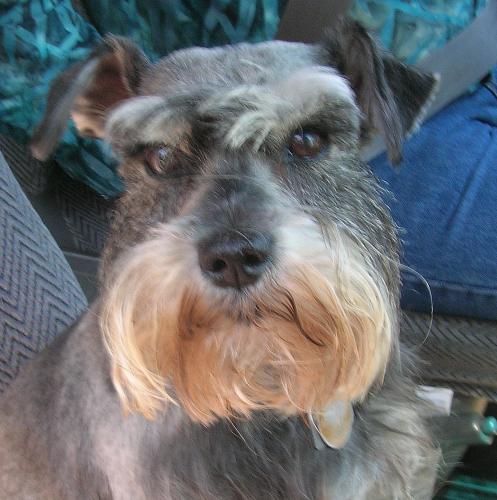
In the end they helped the small community. And, to maintain balance here’s a picture of their dog. Muji.

Muji.jpg

Muchie is a, mostly Siamese, Tortoiseshell Point. Muji? A miniature Schnauzer. Both are special needs animals.

Attention! Detail.

se_in_the_Shunryn_Suzuki_Transmission_Linage.jpg
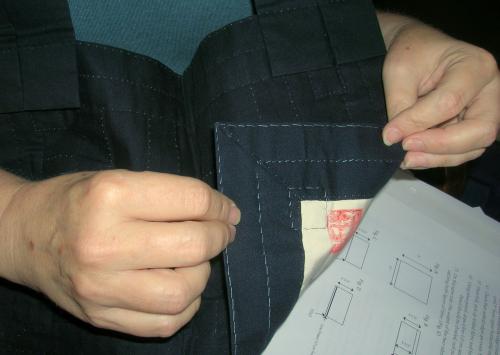
Jean’s hands, Jean’s handiwork. And Jean, inspired sewing teacher at Berkeley Zen Center. Detail of the Namu Kie Butsue Stitch on face and reverse side of the small kesa in the Shunryn Suzuki Linage.

“namu” Means “homage”
“ki” means “to plunge in”
“e” means “to rely on”

In English Namu Kie Butsue translates as “I take refuge in Buddha”
With every stitch made during sewing the small kesa the refuge in recited, I’m presuming silently.

While the small kesa I wear and Jean wears are sewn quite differently, mine machine stitched and hers hand stitched, there is not a stitch that separates in the deepest sense. A few hours sitting in her sewing class was a very relaxing end to a magnificent morning when we celebrated the Festival Memorial for Zen Master Dogen, who extols us to study in detail.

As well as being introduced to several nifty sewing aids I learned, under Jeans compassionate tutelage, how to sew the Namu Kie Butsu (kyakushi)Stitch. Having a teacher rather than following instructions was a real boon. What really impressed me however was the attention to detail at every level, and at every step in the process, of sewing the small kesa. There’s much to take note of.

I’ll probably sew a full kesa by hand one of these fine days and I’ll be using the stitch I learned today. And I’ll remember with fondness the balmy summer afternoon I spent sewing with fine company.

Bows of gratitude to Jean Selkirk compiler of Buddha’s Robe Is Sewn, instructor, and all round enthusiast for attention to detail.

See also, Buddha’s Kesa Is Lived.

Tea Bag Teaching

We must be
The change we wish to see
In the world.
Mahatma Gandhi

Found on the paper tag hanging from a Celestial Seasonings tea bag, English Toffee flavour I think it was.

This quotation was used by my monastic colleague during her Dharma Talk today
when making the point that one endeavors to be the Precepts, to be Compassion.