Guest Post – There Was A Time…..

In her ‘spare time’ Karen continues to reflect on her marriage, whilst in the midst of the ‘grit and joy’ of her daily life. These words are published here because they reflect a depth of devotion and firmness of commitment, on both her part and her husbands. They have left their front door open for us to walk in through. I bow to that generous offer. And respect it.
See also Karens first post in this series, Up Against It…

Writing is an interesting process. I think it may be different for different people but right now, for me, it is part of a gentle, inner turning; a kind of song that needs to be sung. I do hope the reader won’t mind if I sing it.

I look at my little altar, across the room and my eye rests upon the photograph in its pewter and turquoise frame. I am drawn into the scene; David stands tall, though bowing his head slightly to his right to meet with mine, the top of which just meets with the bottom of his chin. We pose for the photographer; it is our daughter’s graduation celebration. He looks strong and young, belying the slow creeping of rheumatoid disease within.

I once heard a doctor describe rheumatoid as ‘cancer of the joints’. This is an apt description, I think, though an emotive one. I can barely remember a time when he didn’t have it.

But there was a time………

They say that opposites attract and there are all sorts of reasons, both practical and spiritual, why that is often a good thing. Speaking for myself, I saw in David, many qualities that I searched for within myself- steadiness and ‘stickability’ being two of them. For as much as David was a ‘steady sort of guy’, I was, quite frankly ‘a bit of a dreamer’. I loved to dance; he loved to sit in the corner with a book and, dare I say, a pint of good ale. On the other hand, I’m up for a bit of ‘risk taking’ whilst David prefers ‘safe ground’. Living together for 33 years has had the effect of ‘evening things out a bit’. There has been a necessary ‘meeting in the middle’, which feels like a positive.

Though we were both born and bred in Shropshire, we had quite different upbringings. David was the son of a police sergeant and his Irish Catholic wife, Kathleen, who took up several country beats, in his career, requiring the whole family to move, sometimes at short notice. David was born in Cleobury Mortimer but lived for the majority of his childhood in Bucknell – Welsh border country – acquiring a thick, regional accent that sounded like a foreign language to the inhabitants of Bridgnorth, where the family eventually settled. He was the eldest of four children and although money was often ‘tight’, he recalls the strength and security of being part of a large, close-knit family. He has many happy memories.

I, on the other was born in Bridgnorth to a carpenter, turned insurance salesman and his land girl wife. My parents always dreamed of farming the land together and raising pigs and geese. They moved someway to fulfilling this dream by renting a small holding, keeping livestock and breeding dogs. The ‘dream’ however, was stinted, when the marriage ended after only eight years, leaving my mother a single parent to my sister and me. I too was the eldest child. I too have happy memories and many sad ones, also.

These two childhoods were very different, in many ways but there were three distinct similarities. Firstly, there was a sense of the nomadic about them. For, as David’s parents were compelled to move frequently because the life of a country ‘bobby’ dictated it, so my mother, searching for work, a sense of stability and a glimpse of happiness, also moved from place to place trying to find it.

Secondly, as eldest children, we both bore the mark that many first children have; an overburdening sense of responsibility. This sense of responsibility, intertwined with the accompanying fear, has been the ‘root’ of much individual suffering, for both of us.

Thirdly, and most importantly, from our very first memory we have both had a sense of something greater than ourselves and both sought to understand and ‘serve’ it. In youth, David was an altar boy in his local Roman Catholic church, though he talks of his most ‘spiritual experience’ being sitting quietly, on his front doorstep, with the family spaniel, listening to the wind. Likewise, a regular in church, until my mother was told she wasn’t welcome for divorcing my father, my most transcendental moments have been those spent in solitude, ‘sitting’ quietly with nature, in my childhood tree house, the local woods and fields or by the brook.

By spring, 1975, both sets of parents had settled into a semi-permanent residency. David’s family lived in a residential area of Oldbury Wells, on the outskirts of Bridgnorth town. Whilst my mother, after ‘uping sticks’ and moving several times, had by now ‘settled’ in a cedar wood bungalow in the more rural area of Oldbury. Though we had no knowledge of each other, all that separated us was a field, a church and a short section of road. Soon those three features would be most significant in our lives. We would ‘court’ in the field, marry in the church and a late evening walk along the road would result in an accident that would impact on our lives, long after skin had healed and bones were mended. But that is for another time, perhaps, not now; for the light is creeping in around around the edges of the room. I can hear David, in his converted garage, downstairs, moving a glass, taking his ‘pills’, it’s time to get up and start the day……….
Shoes

1Shoes_and_boots.jpg
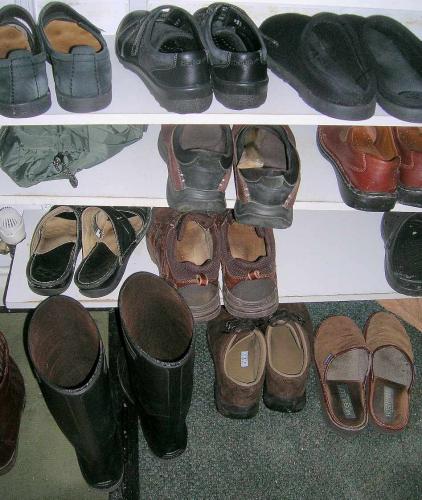
Boots and shoes where I live.

If someone leaves shoes in disarray, let us silently set them to order, such an act surely will bring harmony to the minds of people around the world.

Thanks to Pascal for this quote – found on a postcard from Eiheiji temple in Japan.

And from Karen, also left as a comment and also too interesting to leave hidden:

This article puts me in mind of a time, many years ago, when David and I took our three children to a Buddhist family camp in the Theravada tradition. Though of course, the monks and laity had many ways of training with and manifesting compassion for both self and others, putting their slippers straight, as in the Zen tradition, wasn’t one of them. Being still ‘green’ to the true purpose of this practice, I found myself greatly ‘phased’ by piles of scattered shoes outside the meditation hall door. It took me a good 24 hours of persistent shoe tidying before I finally stopped, laughed at myself and let it go!


See guest post, First Things….
about the teaching of putting ones shoes straight.

Guest Post – First Things….

Rev. Master Koten is a senior monk of our Order who I greatly admire and respect. He lives with his disciple, and others, at Dragon Flower Mountain in the interior of British Columbia, Canada. See the temple website for more teachings by Rev. Master Koten – there are photographs too.

They say the first thing one learns in a Zen monastery is to put one’s shoes straight and at least in Japan there is always a sign to that effect right at the front door. It is even said that this is the first koan assigned to a trainee because if this point of first mind can be thoroughly understood the whole point of Zen training can be accomplished.

Too many people think that the whole idea is to regiment one’s life as if the army would not do a better job of teaching this. No, no, no, a thousand times no! The purpose of the first koan is the calm and compassionate consideration of others, of all beings, always including oneself. Indeed, this is the point of mindfulness training as well.

To watch what one is doing as well as what one’s mind is doing is the perfection of Bodhisattva practice. This manifests in the smallest of ways. When we take the time to replace the toilet paper roll that has run out, when we place our empty tea cup down carefully where it will not be knocked over, when we put down the toilet seat when we are done peeing, we benefit beings by helping to free them from the miseries of frustration, anger and judgmental mind. So easy and so wondrous!

Our ability to see what needs to be done and to do it arise out of the practice of mindfulness and calm compassion and it is this that makes the life of a community, whether of one, two or twenty-five possible. This is why the putting of one’s shoes straight is the first thing.

In gassho,
HKoten

Very many thanks for permission to publish this article which also appears on the temple website. It is the first guest post by a monk of the Order.

Responding To Human Plight

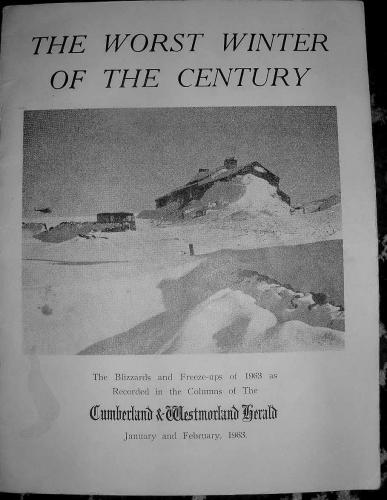
The thaw has come and with it the guttering, laden down with ice, is being yanked off the roofs. One valiant monk has been hanging off a ladder chipping away at the ice, with what looks like a climbers ice axe. All in an effort to save the guttering still in place. Still the thaw is on, it is now over a month since we saw grass. However this weather ‘event’ has not come even close to matching The Worst Winter of The (last) Century. That was January and February 1963. I remember seeing swans frozen into the river as I walked to school. A terrible sight and nobody could reach them either.

1worst_winter_0.jpg
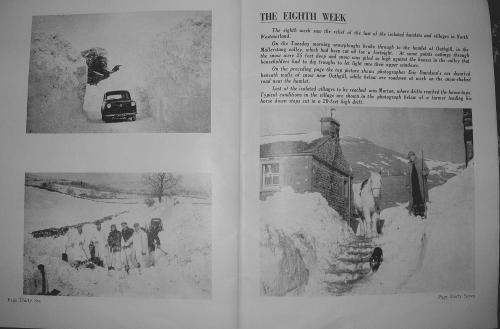
This compilation of photographs sifted to the surface while dealing with Iain’s books last week. A happy find especially as I was slap in the middle of the area covered by the booklet.
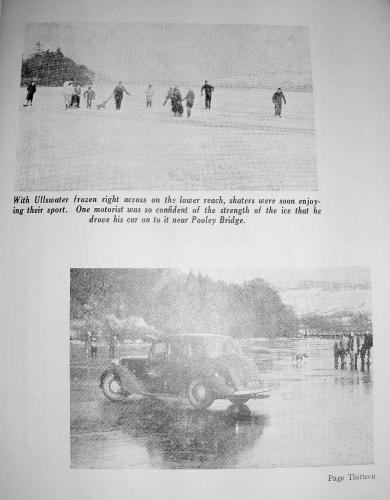
1Ulswater_frozen_over.jpg
With Ullswater frozen right across on the lower reach, skaters were soon enjoying their sport. One motorist was so confidant of the strength of the
ice that he drove his car on to it near Pooley Bridge. (only in England!)
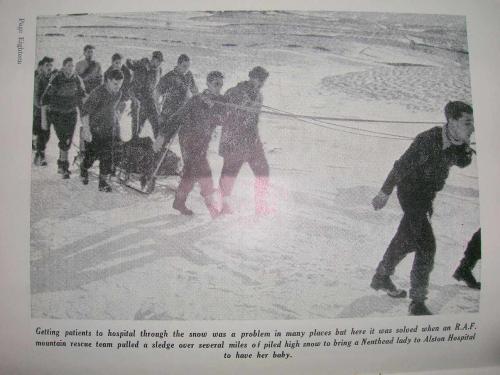
1RAF_Mountain_Rescue.jpg
Getting patients to hospital through the snow was a problem in many places but here it was solved when an R.A.F. mountain rescue team pulled a sledge over several miles of piled high snow to bring a Nenthead lady to Alston Hospital to have her baby.
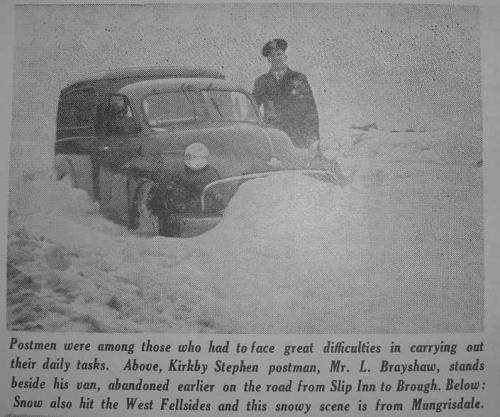
1postman_1.jpg
Postmen were among those who had to face great difficulties in carrying out their daily tasks. Above, Kirkby Stephen postman, Mr. L. Brayshaw, stands beside his van, abandoned earlier on the road from Slip Inn in Brough.
1Week_eight_0.jpg

The eighth week saw the relief of the last of the isolated hamlets and villages in North Westmorland. On the Tuesday morning snowploughs broke through to the hamlet of Outhgill, in the Mallerstang valley, which had been cut of for a fortnight. At some points cuttings through the snow were 25 feet deep and snow was piled so high against the houses in the valley that householders had to dig troughs to let light into their upper windows. …the text continues.

What are we to make of all this? Extreme weather is newsworthy. Plight, others plight, news of others plight is our chance to express empathy for those less fortunate. To ‘have a thought’ as I often term what I would understand as offering spiritual merit into situations. The appropriate response to news of plight is to ‘have a thought’, to purposefully stop and literally allow empathy, compassion and love flow. Sadly plight, the news, can become, does become, entertainment….