All posts by Mugo

Cheap Tin Trays!

Imagine.
A bored child
In Sussex
By the sea.

Poetry.
Rhythm
Music
Imagination.

Rhyme
Dance
Playful
exotics.

Today guests arrive for an ‘intensive retreat’, with a difference. Here is the write up on our website introducing the retreat.
One of the themes of this retreat is around seeing the reading and writing of poetry as a potential ‘path of awareness’. In finding ways to express what seems unsayable, poetry can reveal and clarify our understanding of ourselves. During the retreat, there will be talks/discussions on this topic, which will be integrated with sitting periods.

Those coming to the retreat were encouraged to bring a poem. Below is my poem.

‘Cargoes’
Quinquireme of Nineveh from distant Ophir,
Rowing home to haven in sunny Palestine,
With a cargo of ivory,
And apes and peacocks,
Sandalwood, cedarwood, and sweet white wine.

Stately Spanish galleon coming from the Isthmus,
Dipping through the Tropics by the palm-green shores,
With a cargo of diamonds,
Emeralds, amethysts,
Topazes, and cinnamon, and gold moidores.

Dirty British coaster with a salt-caked smoke stack,
Butting through the Channel in the mad March days,
With a cargo of Tyne coal,
Road-rails, pig-lead,
Firewood, iron-ware, and cheap tin trays.

John Masefield

Everything from the exotic, hard to pronounce words, to those cheap tin trays, pig lead and firewood captured my bored wandering attention. Sitting at my desk I could picture that dirty British coaster filled with earthy items, contrasting with emeralds, amethysts, peacocks and palm-green shores. How unlike Sussex by the sea! The poem fired my imagination and pointed to a distant world beyond the waves I knew. It probably set me yearning to see the world.

There is something to be said for poetry.

Tree Protection – Re Publish

2020 February 18th. One of our trees blew over last night. Always sad when one goes horizontal.

This lunchtime I went out for a walk to stretch my legs. In the fields around the monastery there have been thousands upon thousands of trees planted over the past thirty or more years. Each year more young and tender/vulnerable trees are planted. How they need protection too. From the high winds and from the animals, mostly rabbits, who eat them. There are special plastic tubes that slip over the young single stem whips, as they are called. Then around the tube is a chicken wire tube for extra protection. I could not help but notice the care and attention that has gone into making sure the rabbits are not able to make a break in. Guarding the trees as they grow strong enough to fend for themselves has become an art. Large rocks cover gaps between the chicken wire and the uneven ground they rest on. And I see a square of cardboard slotted around the tree inside the plastic guard to inhibit vegetation growth close to the treelet! We want these trees to survive and the majority do.

There is a link in my mind to what is happening here in the monastery this week. New Baby Buddhas protected by their fresh new promise to keep the Precepts and follow where they lead in life. Tender flowers and we do everything to guide people in what is perhaps the most important journey of their lives. Inwards. The journey had no beginning and has no end yet taking the formal step to commit to religious practice is not nothing. No vow or promise is taken lightly. However, there is much that comes into one’s life to cause one to fall over. And much that weighs one down, causing the picking up of the practice again hard. Really hard.

A ceremony which happened the other night is especially significant. It reflects the need to recognize at all times when one has acted in ways which takes one away from ones own good intentions. Mistakes. Recognize AND accept mistakes – that’s what causes one not to be weighed down by all the self-recriminations, guilt or denial. Acceptance is like the care we take to protect the young tender trees. The wind blows, snow comes in the winter and we get nibbled at from time to time (Oh and we nibble on others too don’t forget!) Recognizing our vulnerability, taking care to take care of ourselves is paramount. During the long and slow procession in dim light which is at the start of the ceremony, there is a chant. Hail Shakyamuni Buddha. Over and over and over again. Hail Shakyamuni Buddha. Over and over and over again.

Just sometimes, when in extremity or not, all that is left to us is to look up. The chant and the ceremony is about looking up in darkness. Faith.

There are no articles of faith in Buddhism, and trust can be used in place of faith. But faith in….what? Trust what? Hail Shakyamuni Buddha. Always we are on Vulture Peak listening to the Buddha.

The Will of The Wind

The plants and flowers
I raised about my hut
I now surrender
To the will
Of the wind

Ryokan

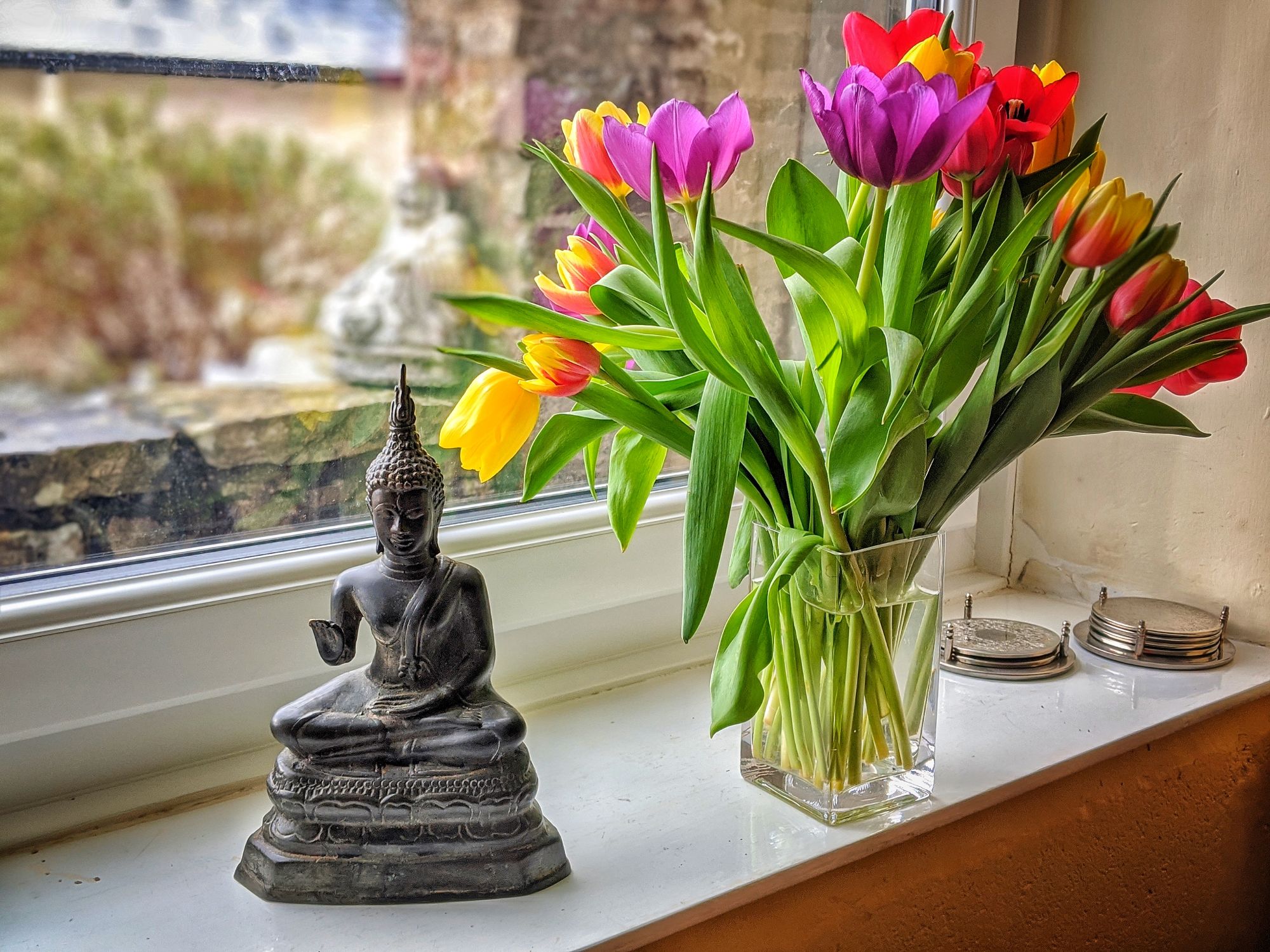
This post is offered for all those who are caught up in the weather drama currently hitting Britain. High winds, flooding and much suffering. The flowers were a donation which we have enjoyed for what seems like weeks. So bright and cheerful. We can all use a bit of ‘uplift’ from time to time as we plough our way towards spring.

The Courage of a Strong Heart

The following article, written by Rev. Oriana was taken from the Eugene Buddhist Priory Newsletter. You can subscribe to receive future newsletters (although it’s listed as a ‘blog’) by going to the Eugene Buddhist Priory home page.

“Whenever a true heart exists, the Dharma springs up also.”
From the offertory for the Founder’s Day Festival, OBC

On Founder’s Day at Throssel last November, the Dharma talk was begun with the above quotation. Rev. Jishin then spoke about how a true heart sees the Dharma and the Dharma sees the true heart. We cannot grasp onto the true heart, as it is not an object or a thing; we can only be quiet and let the true heart enter us. I am reminded of the lines in “Adoration of the Buddha’s Relics”—“The truth enters into us and we enter the truth.” We don’t define the Dharma, we just let it flow without obstructing it with our ideas and concerns. Rev. Jishin goes on to say that “nothing has the significance we give it.” Everything we add—make significant—only obstructs. Can we see this?

When I spoke about the courage of the spiritual warrior last issue, I quoted Rami: “Out beyond ideas of wrongdoing and rightdoing, there is a field. I’ll meet you there.” This is the field of emptiness. This is where the courage of a strong heart resides. The true heart, the strong heart, allows itself to be touched by both the “good” and the “evil.” It makes no distinction. That is, we have the courage to stay with our experience however we may see it. The courage of the strong heart doesn’t reject what is in front of it but receives what is happening right now. This opens us to compassion for the suffering of all beings—all beings.

In his book, Ostaseski gives an example of the courage of the heart that I would like to share with you. A 14-year-old American student brought his parents’ gun to school and began randomly shooting, wounding 2 students. Jencie Fagan, a teacher at the school, approached him, speaking calmly, and talked him into giving her the gun. This is the courage of a spiritual warrior who engages in “the mindful practice of touching with mercy and tenderness that which we previously touched only with fear.” Then she held the boy, continuing to talk to him, promising to stay with him through the arrest process. This is the courage of a strong heart. No separation. This is what Ostaseski calls “fearless receptivity.” I like that very much: “fearless receptivity.” Yet there is something in me that would like to encourage us to be receptive even in the presence of fear. Isn’t that what we do? In the moment, we overcome the fear. This is what is happening. Right now, what is it good to do? Let your heart and body move, trusting that a true response can arise even in the midst of fear.

In The Transmission of the Mind, Huang Po, 9th-century Zen monk, speaks of the courage of the heart.

“By the Dharma is meant the heart, for there is no Dharma apart from heart. Heart is no other than the Dharma, for there is no heart apart from the Dharma. This heart in itself is empty, and there is no empty heart either. When the empty heart is sought after by the heart, this is making it a particular object of thought. There is only testimony of silence, it goes beyond thinking. Therefore it is said that the Dharma cuts off the passage to words and puts an end to all forms of mental activities.”

There is only testimony of silence, unobstructed by words, striving, or belief.

I am reminded of Vimalakirti’s “tremendous silence.” In the Vimalakirti Sutra, written around the 3rd century, wise layman, Vimalakirti, invites bodhisattvas to describe how they became fully aware of the reality of non-duality. Each bodhisattva gives an account of how they transcend various dualities: happiness and misery; purity and impurity; distraction and attention; birth and death and so on. Then Manjusri, the bodhisattva of great wisdom, asks Vimalakirti how he overcomes duality. Vimalakirti remains silent. In the literature, this is often referred to as Vimalakirti’s “thunderous silence.” Anything that Vimalakirti says, any words, will divide the truth—it is this and it is not that.

When we move beyond ideas of good and evil, we are moving beyond seeing the world in a dualistic way. Here, we find the courage of the heart, the true heart that is not apart from the Dharma and, in the end, cannot be expressed in words.