Where To Start?

starting_point1.jpg

We say to start where you are. To deal with what’s in front of you. And, the next step is found within present conditions. There are probably lots more ways of saying the same thing. However in the end one just has to move and do something, but what? What a clamor there is in our lives and it’s good to remember there is more to living a life than clamor. Even sitting still can become another doing clamoring away. As is obvious I chose to first write a post here. It’s so good to have the time and space to devote to this activity.

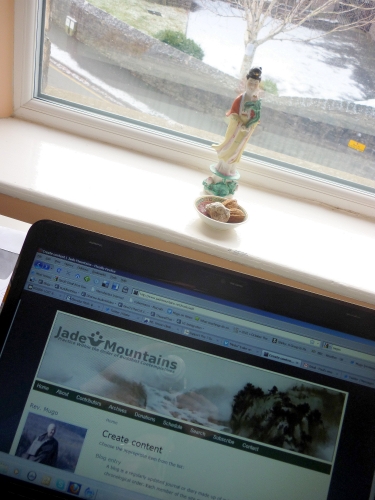
Here’s what’s in front of me this morning. My computer is opened and ready to write a post for Jade Mountains. Further out a dish with two walnuts from Butchart Gardens, Victoria Canada and a piece of picked-up-and-passed-on pumice found during a trip to Medicine Lake and Glass Mountain, California. Next a Kanzeon holding a lotus. Outside, a dusting of snow. This is the view from an upstairs window where I am staying this winter. This then is what’s before me this morning.

Then there is the rest of the desk with papers and items all calling and competing for attention. Petty cash to balance, a short video calling from a flash drive to watch and respond to, a book of poems by Seamus Heaney (Human Chain) quietly whispering to thank the couple who gave it. Oh and there is the bank to deal with, personal business, that announced they had closed my account while I have been away, and to my right a pile of cards ready to be written and sent off. They are thank you cards to temples and their communities for hosting me this summer.

Behind, beside, above and below. The phone, the email, Google Talk, Skype, Twitter (my ID is revmugo for those who even know what Twitter is) and now back to this. This. THIS! And this is what’s here in the midst of the up, down, above and below. How very easy it is to loose contact/awareness with oneself. The skin, flesh, bones, brain, mind, consciousness of oneself.

We in Buddhism call what I am broadly talking about as the five skandas. Form, sensation, thought, activity and consciousness. That which constitutes self and which (very important to remember this) are not fundamentally separate from conditions. And even more import, to know that the important thing is not something other than THIS. All is all in the up, down, beside, below and behind. (I will be had up for sounding Zen if I am not careful!) At Shasta Abbey there are, I think there still are, five red lights hanging in lotus flowers above the altar. We call them the skanda lights. Jim reminds me that I pointed these out to him years ago, it was our first conversation together.

Anyway. Now as I drive off into the tasks calling to me I’ll take a look in my rear view mirror. Like any good driver knows, first check the rear view mirror. For me this has the effect of bringing me back to THIS. Which embraces the this and that’s I’ve been talking about.

At least, at last, here is an actual post for you all. It’s my first thank you note of the day.

An Old Friend

From a coaster…

ZEN DOG
He knows not where he’s going
For the ocean will decide –
It’s not the DESTINATION…
…It’s the glory of THE RIDE

Edward Monkton

This quote was mentioned while sitting over a cool cup of tea with an old friend on Sunday. Thanks Friend. I had a look at Edward Monkton’s website. There are certainly some zany thoughts coming out of Mr. Monkton. I’m left scratching my head a bit….

Anyway I am posting this quote because it reminds me of the happy Sunday meeting. Twenty years it’s been. How fortunate we are to have shared training in the Way – and can still share a joke, and talk about the important thing.

Thought I was
done with going about.
But I was wrong.

A week of here and there
only to come back again
to rest and hopeful repose.

Silent Music


Here’s a musical piece in three movements where the orchestra plays, not a note. Four minutes and 33 seconds with only ambient sound. Well, except for sound of coughs and wriggling between movements.

Thanks to Julius once again. He said he played it full screen with headphones on. The third movement is reported to be particularly intense.

Life As It Was – In The Yorkshire Dales

This was originally left as a comments to an earlier post by Angie. Since there is so much here I thought I’d publish as a post in its own right.

People now love to visit Swaledale as one of the most magnificent Yorkshire dales for scenery. My dad always said it was very bleak when he lived there, especially in the long winters. There was a lot of depression & suicides were not uncommon. My auntie thought that was partly because of the brooding hills which seemed to overwhelm some people, & possibly also because of the effect of lead leeching through water pipes into humans.

My dad & his four siblings grew up in the 1920s & 30s, my granddad scraping for work despite his status as a stone mason, the family next door staying indoors on Sundays because they didn’t have any Sunday clothes to wear. People who didn’t have sixpence for the doctor just doing without. My auntie had a story about a man who broke his back at the quarry being brought home screaming on the back of a trailer & put to bed to die without any medication. My granny was very anti drink & ‘signed the pledge’ because families suffered great hardship if the head of the household spent essential money on alcohol.

Electricity made the Dales more acceptable. I still remember in the 1950s taking a candle to go across the yard to the flush (luxury) toilet – fun as a kid but not permanently as an adult. There was in time electric light in the living room but not upstairs so oil lamps & candles were used until the 1960s.

Transport was difficult – I know it seemed to take a long time for us to make the trip from Preston & later Keighley. Now it can be done in 2-3 hours. Then cars broke down & the moors seemed incredibly steep & empty, although as a child I enjoyed the fun of leaping out to open & close all the gates which were later replaced by cattle grids. Buses were on market day or for school in Richmond.

It was a hard life with work a central feature. The family kept some chickens to supplement their income & my granny ran Grinton post office which then included walking all around the dale to outlying farms to deliver letters & parcels, even on Christmas day. Church was a central focus – my auntie played the organ from the age of 14, her mother cleaned the building, her dad dug graves & was a church warden & her four brothers sang in the choir.

Two of my dad’s uncles came back from the first world war very troubled mentally. Their marriages broke up & one was seen around Reeth muttering to himself & writing words in chalk on the pavements. What a shock it must have been to come from a remote village to the battlefields of Europe & back again.

My dad was a conscientious objector in the 1930s when he first went to Oxford University, but changed his mind about pacifism when Hitler overran Czechoslovakia – as did many others. He heard great debates at the Oxford Union with all the famous politicians attending, including Winston Churchill & Vera Brittain. Two of his brothers remained C.O.s through the war which was difficult for his father living in a small community where it was still seen as cowardly not to fight.

Thanks Angie.

Warning Lights

Just why are those people flashing their lights? At me. Driving along this morning, the oncoming cars, the drivers, were flashing their lights. Something wrong with the car? Do I need to stop and see if something is flapping, or dragging along the ground? Something worrisome about the car I can’t see, but they can. There is something going on here. They are saying something, but what?

When something like this happens, drivers communicating something the tendency is to slow down and wonder and be warned. And that was precisely it. The message was SLOW DOWN there is a police vehicle up ahead with a speed camera aboard. Slow down or you will get a ticket! This all set me pondering the whole business of regulation generally. Not to mention the preceptual implications of warning other drivers about speed traps. I smiled inwardly because the police presence may not have caught anybody speeding but it did caused drivers to regulating each others speed. And that, after all, is the point of the police presence. To discourage drivers breaking the rule of the road.

My late father would become very animated when he saw signs on the side of the road announcing speed cameras. He was convinced they were not cameras at all, just dummy cameras. He didn’t like to be regulated like that. He felt it was regulation through deception. And I can see his point. Thankfully he didn’t speed up when he saw such signs!

I heard about a silent retreat where the participants agreed between themselves not to talk to each other. Sounds so simple. How else is silence to be maintained and held to if there is not mutual agreement to BE silent? This is self regulation. And that for the most part is how the sangha functions. Self regulation, guided by Preceptual truth.

My last thought: were those deceptive dummy cameras my father saw? Or was he deceiving himself? Love that dad.

This is for a regular reader, and her father just recently deceased.