Across the road
four Bull Elk
In the pond below
Beaver.
Sun blazing
leaves waving
dogs barking
me sleeping.
All’s well with
the world.
This post is for Jack and for his mother, both in Colorado.
Across the road
four Bull Elk
In the pond below
Beaver.
Sun blazing
leaves waving
dogs barking
me sleeping.
All’s well with
the world.
This post is for Jack and for his mother, both in Colorado.
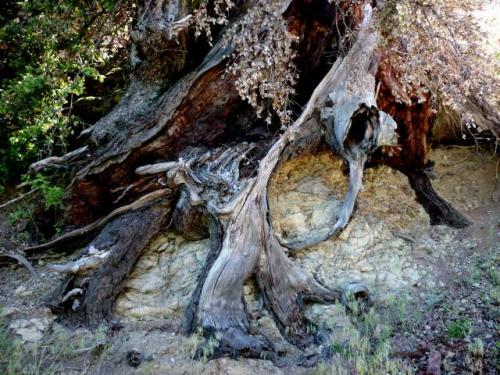
The new Abbess of Shasta Abbey gave a Dharma Talk this morning on the subject of Trust. Towards the end of the talk she speaks of the need to hold fast to trust likening that to those tough little trees that cling perilously to the rocks on mountain sides. Well placed to withstand the winds of the Eight Worldly Conditions.
Human beings must work.
When you are not competent, learn.
When you are competent, do it yourself.When you are not familiar, practice more.
When you want to work,
start immediately.When you are poor,
work all the more.
When you are rich, work harder.If work is done wrongly,
correct it.
When you are old, enjoy working more.
Seen at a Chinese Buddhist Temple in Malaysia.
Translated from the Chinese.
If one thinks of work as action then, indeed, we are working all the time. And I believer that is what the above quote is pointing to. It’s not about the work ethic in the way the word work is commonly understood.
What I am getting around to in this post is to tell you about the meaning of my name. Mu means empty or immaculate and go means action, or karma, or work. So Mugo translates as immaculate action, empty action, empty karma, immaculate karma.
Change the word work to act or action in the saying and something rather interesting comes through. Right there is that begging question. What is my purpose? Why am I alive? What’s my motive? From whence does action spring?
Mugo – (the word) points to the (smiling) heart of the great matter. My name has been, and is, my great teacher and guide. It was given to me here at Shasta Abbey.
This post is dedicated to the recently elected Abbess of Shasta Abbey and the community both lay and monastic. It has been a privilege and a delight to sit and walk and talk and, this evening, eat ice cream with you all!

Snow blanketed Great Britain on January 7, 2010, as the Moderate Resolution Imaging Spectroradiometer (MODIS) on NASA’s Terra satellite passed overhead and captured this image. Snow covers most of England, from the east to the west coast. (The large image shows snow cover over the entire island of Great Britain.) The cities of Manchester, Birmingham, and London form ghostly gray shapes against the white land surface. Immediately east of London, clouds swirl over the island, casting blue-gray shadows toward the north.
NASSA Earth Observatory
Back in January I was in Kirkby Stephen, Cumbria and right in the midst of frigid snow covered Britain. I remember seeing this image on the TV at the guest house where I was lodging and being incredulous. I’ve posted it now for the record. And when I am blazing hot in the Southern California sun in August I might just take a look at this image to remind me what cold feels like. Cold!
I know, When hot be completely hot and when cold be completely cold.
Thanks to Walter at Evolving Space for posting the Nasa photograph and link. Nice photographs too, of flowers.
The idea of the servant as leader (developed by Robert Greenleaf) came out of reading Hermann Hesse’s Journey to the East. In this story, we see a band of men on a mythical journey… The central figure of the story is Leo, who accompanies the party as the servant who does their menial chores, but who also sustains them with his spirit and his song. He is a person of extraordinary presence. All goes well until Leo disappears. Then the group falls into disarray and the journey is abandoned. They cannot make it without the servant Leo. The narrator, one of the party, after some years of wandering, finds Leo and is taken into the Order that had sponsored the journey. There he discovers that Leo, whom he had known first as servant, was in fact the titular head of the Order, its guiding spirit, a great and noble leader.
Robert K. Greenleaf – Wikipedia
The 10 Characteristics of Servant Leaders are: Listening, Empathy, Healing, Awareness, Persuasion, Conceptualisation, Foresight, Stewardship, Commitment to the growth of others, and Building community. Yes! ten times over.
Thanks to Ian Miller for his post nurse as servant-leader which inspired me to delve into the thinking of Robert Greenleaf and others who have developed his vision and out-of-the-box thinking on leadership.
As Ian says, Servant leadership is not a position to be bestowed or awarded by your peers, it cannot even be earned, but rather it is a quality of recognition, returned to you as a gift from those you serve.
Brilliant! Let us aspire to serve thus, with no expectation of reward or recognition.