Goodmorning China!

First published May 11, 2005. Reading this now I am amazed all over again at where (the late) Iain Robinson and I found ourselves while in China. Being in the abbots quarters at Tiantong Temple where Zen Master Dogen met with his master and then next morning being the first female, ever, to enter the dining room at Tiantong were moments never to be forgotten. Under categories in the left hand side bar you will find Pilgramage 2005 where you can find all the posts and photographs from that East Asia trip.

Five days after arriving in Shanghai I am just about getting the hang of it all. It would take more time than I have at the moment to communicate what has happened these past days…and perhaps it is not possible to adequately convey to you. There will be photos so you will get a sense of what things look like.

From what I have seen and picked up from talking to monks and others along the way Buddhism is alive and well and growing. We were very fortunate to stay one night at Tiantong Temple near Ningbo, Zhejiang where Zen Master Dogen came to practice in the 12th Century. We joined in the daily practice with the 100 plus male monks, met the Abbot and even joined a formal breakfast. Doing that was a first for a female western monk, and probably a first for a male western lay person too. You should have heard the silent gasp as we walked in!

We were very fortunate to be traveling along with a novice monk from the Tiantong Temple for three days while we have been here. He escorted us to Puto Shan which is an island one hour ferry ride from the mainland and a major pilgrimage site for devout Buddhists. Ru Xian Shi, the monk, was both an inspiration and a doorway into a China we would not otherwise have known.

There is much to say about these days however I see the clock ticking away. Today we travel by bus, the train line having been closed, to our next destination. Thankfully Ru Xian has written our hotel name in Chinese script as well as instructions to taxi drivers to get us to the bus station here in Ningbo. It cannot be over stated how difficult it can be to travel in China when you don’t speak or write the language.


The pavement where ‘anything goes’ and most things do!

Listening Again

Looking back through posts I see layer upon layer of connection. This saying from Elias Canneti was first passed on to me by Rev. Master Chushin who died earlier this year. It was through him, indirectly, that I found Throssel Hole Priory as it was called then in the 1970’s. Seeing Michael’s comment reminds me of the very many conversations we had over the dining room table about speaking and language at the then Edmonton Buddhist Priory.
Listening
Posted on January 14, 2006 by Rev. Mugo

‘Respect for others begins by not ignoring their words.’
Elias Canneti
From: ‘The Torch in My Ear’

Need I say anything more?

A biographical detail for your interest: Elias Canneti won the Nobel Prize for literature in 1981, “for writings marked by a broad outlook, a wealth of ideas and artistic power”. For the last 20 years of his life he live in Zurich. He is buried there beside Irish author James Joyce.

Comments:

Michael on January 14, 2006 at 10:43 am said:

One of the best thing I learned in that book on “Transformational Speech” is that public speaking isn’t so dependent on speaking to the audience as listening to it. It’s a great challenge that I haven’t conquered yet.

I was talking to a fellow today about my profession and I caught myself a couple times thinking about what I was going to say next while he was talking. Tch tch.

One more example, I can always tell when the assistants I’m supervising have tuned me out when I’m trying to give them direction. What are they thinking about?

David Gwillim on January 16, 2006 at 10:19 am said:

Thank you for the quote by Elias Canneti, I had never seen or heard of that before, but it is something to which I have naturally always tried to adhere.

I find it works wonderfully as a personal point of resolve, but it is extremely difficult to use as a complaint when you are having difficulty with someone who is ignoring your words.

I guess it is another one of those things that simply must originate from within oneself, and cannot by its very nature be enforced.

David

The Laughing Buddha

This was first published November 20th 2006 soon after I’d returned to Throssel Hole Abbey from Edmonton Canada. The wind can surely wather up on the moors of Northumberland! I believe the letter quoted below is from somebody who still reads here. And glad of that.

Most of the people who came for retreat have gone, the rain is chucking it down and the wind is wathering (as in Wathering Heights).

The monastery was recently given a collection of small Hotei statues and I adopted the majority, with a view to giving them away. Two went with one person to Newcastle and two more will be going to Malaysia tomorrow, I know they will all have good homes. In the East when people have statues they no long want they take them to the temple and it is understood that visitors can choose one and take it home. There is no price you can put on a Buddha statue.

Here is an extract from a letter I received after giving a talk on Hotei a couple of years ago.

Dear Rev. Mugo,
Your talk touched a spot for me that I had been tangling with for some time. I think I need to take more notice of what Hotei teaches, he sounds like my sort of guy. Do you remember sending me a bookmark? Well I put it on my shelf with my collection of little treasures, shells, stones, seedpods etc along with a small statue of Hotei stretching his arms upwards. The words you wrote read, “may you be well and happy”. I have looked at those words and statue many, many times when I have been feeling low, almost with despair and disbelief. When I’d repeated the words in the Litany of the Great Compassionate One “a joy springs up in me” I had practically choked.

Last night I felt quite emotional for various reasons but something leapt in me, that sounds a rather superior way of describing a sort of jerking, yawning and stretching that was yelling YES YES. Looking at Hotei this morning really made me smile from ear to ear and I felt that I had to share this with you and to wish you joy.

In gassho,

I have a feeling that one of the monks, not a million miles away, will have the statue I’m thinking of and I’ll take a photograph and post it.

The merit of this posting is offered to a good friend of the Order who has given of herself unstintingly and who is facing serious health problems at the moment. May you be well and happy.

Go Unstintingly

First published 29th January 2006. I was in Edmonton, Alberta Canada at that time. Traditionally that end of January would be the coldest time with sub zero temperatures. But that year the snow didn’t come and we basked in -10c sunshine! Or perhaps a bit colder with windchill.

This morning during meditation instruction, somebody who helps with the instruction, talked about his journey into Buddhism. Some years ago his younger brother had said “Buddhism points the way” and, “it’s up to you to find what the Buddha found”. The first teaching the Buddha gave after he realized enlightenment was the Four Noble Truths. “I already knew about the first two” he said; unsatisfactoryness (dukkha), and craving (tanha) which is its cause. “And the other two I didn’t know about, however I took them on faith until I prove them true for myself”. For him that ‘s what made Buddhism a religion, the faith bit. He took it on faith there is an end to unsatisfactoryness – the third Truth and there is a proven path – The Eightfold Path – the forth Truth.

The popular view of organized religion, viewed with a questioning mind, appears to prescribe what one should and should not believe in. This was the way I saw things as a young woman and kept away. Now I see this as, at best, an incomplete view. Looked at from the outside any religion appears prescriptive and heavy with doctrine, including Buddhism. And that is, to a certain extent, necessary. It is necessary to describe a ‘doorway’ so people can see it, recognize it as a valid one and then choose to walk through it, or not. One often hears that “all paths lead to the same Truth”. Maybe, maybe not! The important thing, if one is seeking a path, is to choose one and follow it unstintingly. (Unstintingly means ‘with generosity’, in this case generosity of spirit (Dana) giving and letting go, unconditionally.)

I inherited my questioning nature from my father. He was a deeply spiritual person, who felt no need to be attached to a faith tradition although he’d say, if he were to be anything, he’d be a Buddhist. In his latter years, when I’d become a priest, he spoke a few times of his inner life. Relating his evolving understanding into the nature of existence, that had begun as a young boy. He was matter of fact when he spoke of these profound matters, and they were profound, some being outside of my personal experience at the time. Through out his life he’d felt no need to label his experiences and there was not a sign of a person burdened by understanding. Some people blossom within a faith tradition and some, like my father, grow and flourish like a tree in a forest. Who is to say which is best?

In 1980 during our drive to Heathrow, on route to Shasta Abbey to become a monk, I felt the need to explain myself to my dad. “Err, I am going to be a monk to find out that I don’t need to be one”. It was half an apology to him and half an explanation for myself. At the time I knew nothing of his inner life only his attitude towards ‘organized religion’. He and my mother supported me in my decision as, in my early thirties, I was free to make my choices and they respected that. If my father were still alive I’d let him know, “I didn’t need to become a monk, however I’m glad that I did”. The practice has changed my life for the better.

Recently there have been a number of younger people who have received meditation instruction and returned here to the priory to meditate. One such person came this evening, another tree that has been growing in the forest, and doing just fine. I’m at once encouraged that such individuals have found the door and walked through and concerned that in some subtle way they will become hindered by a hope of, or desire for, a journeys end. Paths, after all, imply they lead somewhere. Perhaps, like me, they will eventually realize they didn’t need to walk through this particular door and at the same time, be glad they did. Trees grow and flowers blossom within a Great Benevolence not bound by time or place. I hope and pray I’ll not get in their way as they shoot up past me.

Moving Mountains provides a window on one particular Zen Buddhist monk’s daily life practice, and that is all it is. If reading it points the way and encourages you to keep following your path, whether or not it is part of a faith tradition, then that is good. However, voyeurs beware; you might find yourself pulled through the window in spite of yourselves!

This posting is offered in loving memory of my father, Tony White, who died 29th January 2000. His remains are buried beside my mothers in the grounds of Throssel Hole Buddhist Abbey. They both requested Buddhist funerals which I conducted.

 

Growing In The Dark

This was first posted in November 2005. I’d recently returned to the Edmonton Buddhist Priory after traveling to East Asia and the UK. Thank you Miles for suggesting this post be republished.


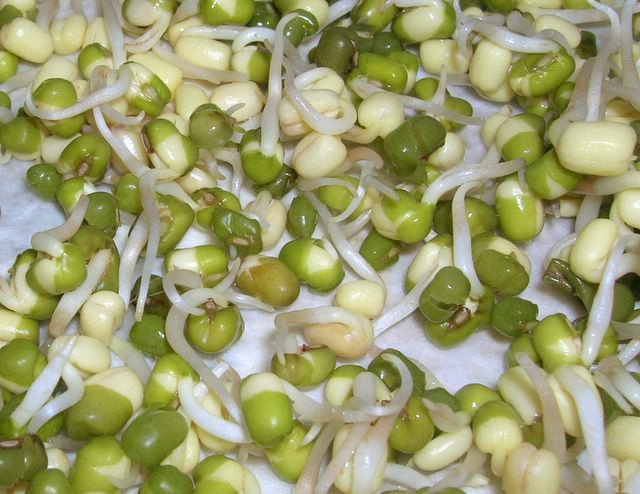
Mung bean sprouts, good enough to eat.
In order to ‘wake up’ the bullet hard beans one needs to soak them in water for 48 hours then, having softened up, they have the potential to sprout. Next they are drained and left in the dark to grow. (The soaking water is an elixir for plants, they love it.) It isn’t enough to just leave those beans, they need to be flushed with fresh water about twice a day or they will dry up. When ready, you eat them. They are very nourishing, but I’ll not go on about that.

I usually sprout green lentils and they are ready to eat in about three days. The mung beans seemed to take for EVER! Even then there were a few bullet beans remaining among the plump sprouted ones. Time to deal with this sort of project is in short supply however I knew I needed to sift out the hard beans, or I’d likely break a tooth on one of them. That’s time consuming work, “do I have time for this”? I asked myself “is it worth the trouble” I complained! Then I thought if there is time to sit and face a wall there has to be time to stand and pick through these beans. Dear Dogen Zenji, weep not for me! For those of you who may not be familiar with his teaching the nub of it is that it is a mistake to believe there is a separation between ‘practice’ and ‘daily life’. Here is a quote from Rules for Meditation by Dogen Zenji: “To live by Zen is the same as to live an ordinary daily life”. I hasten to add here that a goodly part of his life’s’ teaching was answering the question “Ok, so if that is the case why bother to practice then”?

A recent phone conversation inspired me to write the above since it pointed so clearly to meditation where ones spiritual potential grows ‘in the dark’, is watered by ones best efforts and then benefitted from (eaten) in ones daily life.

A much-desired promotion had eluded this person and the news hit hard. There was great disappointment, as well as envy and jealousy eating away in the background. “I have to let go now”! “Sob”. My question was, “OK, however are you willing to let go?” The reply came “But I HAVE TO let go”! “OK, that is all very well, however are you willing to let go?” “Well, I’m not there yet. I’d be telling a lie to say I’m willing”. The conversation went on and in the end the person said, “OK, I am willing to be willing to let go”, it was a step and not an insignificant one either.

When all Else Fails.
What can you do? When you can’t let go?
Simply, Tenderly, Lovingly open your hands.
That’s being willing, to be willing, to let go!
Sometimes (quite often) that’s the very best one can do.

Offered to all those who face disappointment and wish to go on beyond it