All posts by Mugo

Reinforcements.

Copied below is an email exchange which has some content in that may be of interest. It is published with the persons permission.

What’s your/the soto zen point of view regarding positive self-talk? I understand (well, likely not, but you know what I mean) the benefits of looking at things as they are, but doesn’t a person sometimes need to lie to themselves a bit to feel better sometimes? Or just focus on the positive to get through a tough time?

Dear Friend,
In brief, telling the truth is telling the truth, be it to others or oneself. Telling oneself little untruths is like giving candy to a crying child. It works for awhile but doesn’t address why she is crying. As for feelings. Where there is feeling, good bad or indifferent feelings, there is an aspect of the ‘being’ (you) waving her hand (so to speak) and saying “hay, you can let go of this”. “Take a look“. This is the arising of the koan in daily life and the solving of the koan too if one chooses to: one, listen and two, act wisely where action is called for. The Buddhist precepts come in here as well as Compassion of course. Often it is only when somebody realizes that they hurt deeply, (really badly and for a long time), and they want an end to it that they take up a religious practice. That’s when they have really really ‘had it’ with pain and suffering, and at the same time trust that there is a path out of it. Amazing as it might seem it is often the case that realizing ones suffering and finding a religious path can happen around about the same time.

As for ‘being positive’. We talk about ‘looking up’, not looking down, maintaining a ‘bright mind’, that sort of thing. All point to not indulging in self pity and woe while on the other side of it, not deliberately going into another kind of self, a positive one. There is a difference between trying to think oneself into ‘being positive’ and ‘looking up’ which is not about thinking something. It’s more about returning to paying attention in the present moment. Look down and you are mentally stumbling about in the dark and tripping over oneself constantly. Difficult to explain all of this however all roads point to meditation. In this case returning to daily life meditation. That’s just doing what you are doing and not obsessing about what’s going on in the mind/body however nasty it might feel. Simple, yet not easy. There is a lot to all of this, however that’s the gist.

OK I guess if all else fails, the chips are down etc, it’s best to focus on the positive rather than dwell in the negative. It is just that there is this basic problem there. Negative and positive are just two sides of the same coin and to flip from one to the other side and back is ‘work’. Better by far to simply hold the coin, be still with it/within it and let the good and the bad times roll on by. Reference to a song there I think! We call this traveling the Middle Way.

Your question was a good one, simple and straight forward. I like ’em that way. I think this exchange would make a good blogger posting. Are you OK with my doing that? In gassho, Mugo

Sure! I asked (my question) because I’ve been depressed for a few days and was wondering. Thinking positive helps sometimes, but then I remembered reading stuff about…stuff…that made me question that practice. Not that I’m going to completely throw it out. Sometimes it’s useful. Thanks for your answer. I’ll have to chew on it.

Had you tried getting out and walking, briskly. That can help lift a depression if it hasn’t gone too heavy. Mugo

Oh yeah, I’m also really feeling it – not meditating regularly. I was noticing the effects, even of not going to your place (the priory) anymore. I’ll be glad when I can attend again next week. It’s really hard for me to get into sitting once I’ve fallen out of it.

So true, so very true for all of us. It is hard to get back into sitting. However, do you ever take a long break from cleaning your teeth? Think about, habits get to be habits through repetition. In gassho, Mugo

True!
I wasn’t down last week, and last night just wanted to relax. I’ll be busy all this week, too. I was starting to meditate and exercise regularly – then really overbooked myself. Oh well.

Middle Way, all the way.

:)
Reciting on F

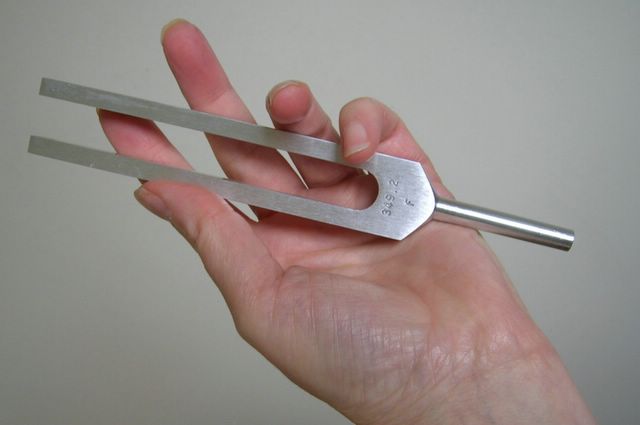
How many times have I walked into a music shop and asked for an f tuning fork only to be met with kindness, to be sure, but no promises of an f fork? It would seem they are not used much and so for years my efforts have been in vein. That is until the other week when I strolled into a music shop, in the now famed, Whyte Avenue close to the Priory. The sales woman, Lisa, went to a lot of trouble to track down a source for me and the other day I picked up this one. A magnificent aluminum tuning fork, it’s a whopper too.

Our scriptures were translated into English and set to Gregorian chant by Rev. Master Jiyu-Kennett and much of what we sing has a ‘reciting note’ of f, thus the need for the fork. It is paramount to start off a scripture on the right note as things can go down hill, musically, very fast if you don’t. When I’m precenting I prefer to use a tuning fork rather than a pitch pipe as a pipe, powered by breath, can sound a bit odd ‘honking’ in the middle of a ceremony!

In an interview Rev. Master gave with Lenore Friedman she spoke about translating the scriptures and setting them to Gregorian chant. Which is a variety of plainsong by the way, something I’m glad to have got clear for myself. That interview, along with interviews with other leading female Buddhist teachers in North America, were edited into a book entitled ‘Meetings With Remarkable Women’ published by Shambhala. It came out in the 1980’s and has since been republished in a Revised and Updated Edition around 2000. It’s well worth getting hold of a copy as, apart from the references to music, the interview give a sense of Rev. Masters’ humanity and great sense of humour too. Also Lenore paints a picture of training at Shasta Abbey, as seen through her eyes during a weekend stay there.

Here is an extract from the aforementioned interview for your interest:
“…there are twenty-four scales in Gregorian—and there are peregrinating ones as well. Which means if you choose the right ones, you can avoid the emotionalism. Interestingly enough, regarding our major and minor scales, the major is one of the twenty-four, which is the war scale. All our major music is written in the scale that encourages anger and violence. And all our minor music (which is the Aeolian) is the death scale, in which people made all their funeral music.” “I do most of mine in the Phrygian, which is very cool and starry and still. And it gives the perfect effect. I also use the peregrinus mode because that’s extraordinarily good for very long lines.”
From
Meetings With Remarkable Women, published by Shambhala.


Well, this has all been very instructive. I expect there are readers who know a lot more about plainsong, and music generally, than I do. I’m no expert. If anybody needs to get a copy of our Scriptures and Ceremonies you can buy a CD, or an audiotape version, from the
Throssel Hole Buddhist Bookshop. They may well ship to North America.

Polly Magoo


Bit of a change o’ pace for to-days posting.
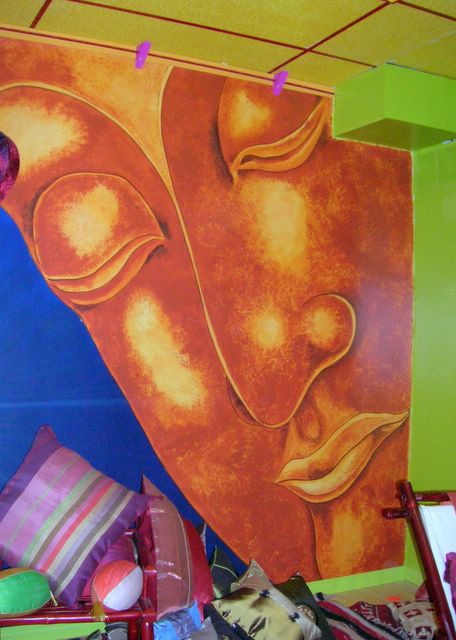
The above map should give you an idea of the scale of the Edmonton area and where the Priory is. At the top of the big N of Edmonton is Whyte Avenue the main ‘hanging out’ and local shopping street for University students. I can reach Whyte walking, at a brisk pace, in 15 mins. The Priory bank is there as is Chapters the bookshop chain where I go yet seldom buy. Polly Magoo’s is on Whyte Avenue and long established too, by modern standards. This is a very colorful gift shop with imports from Asia including Buddha statues, the staff are friendly and helpful. Last year towards the end of November Rev. Master Koten of Lions Gate Buddhist Priory in Vancouver came to visit for a couple of weeks. Andrew, a layman from England, was here at the same time and it turned out to be a very memorable time for all of us.

It didn’t take long before Rev. Master Koten and I were out window shopping on Whyte. To cut a long story short we quickly found ourselves hauling back a heavy statue in a snow storm, bought at Polly Magoo’s. At the same visit I spotted a statue of the Healing Buddha which I connect with, loved it in fact. There was some question as to whether it was for sale or not, however eventually over about a week all the staff got on the same page and now it sits as the Buddha on my private altar. The staff were burning incense stick in the hand of the statue. I wince now at the thought. The other day I bought a small piece of Lapis to place in the open hand. Lapis is associated with Bhaisagjyguru by the way.

From time to time I drop into Polly Magoo’s to visit the statues. The staff remember me as ‘being with the monk who painted a statue’ they had sold. They recently moved a few doors down the street and the have completely remodeled inside. They were glad to show off their new ‘Buddha corner’. Well, I couldn’t not take a photo of the mural painted by one of the staff, Kelsey Nowaczynski.. Here it is:

Hopefully there will be a photo of that painted statue mentioned and also one of the Healing Buddha too.

Growing in The Dark.


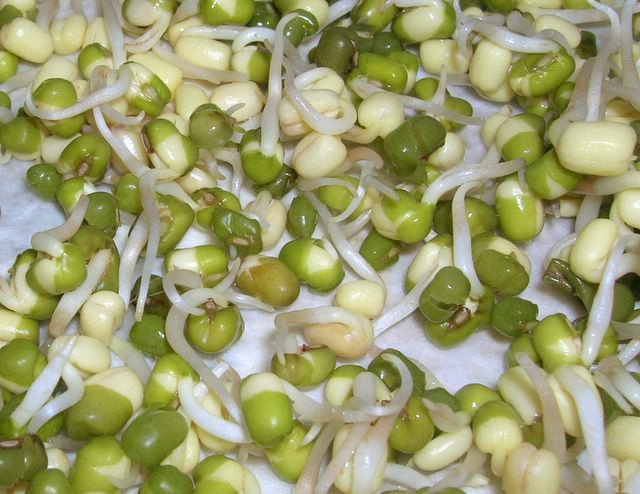
Mung bean sprouts, good enough to eat.

In order to ‘wake up’ the bullet hard beans one needs to soak them in water for 48 hours then, having softened up, they have the potential to sprout. Next they are drained and left in the dark to grow. (The soaking water is an elixir for plants, they love it.) It isn’t enough to just leave those beans, they need to be flushed with fresh water about twice a day or they will dry up. When ready, you eat them. They are very nourishing, but I’ll not go on about that.

I usually sprout green lentils and they are ready to eat in about three days. The mung beans seemed to take forEVER! Even then there were a few bullet beans remaining among the plump sprouted ones. Time to deal with this sort of project is in short supply however I knew I needed to sift out the hard beans, or I’d likely break a tooth on one of them. That’s time consuming work, “do I have time for this”? I asked myself “is it worth the trouble” I complained! Then I thought if there is time to sit and face a wall there has to be time to stand and pick through these beans. Dear Dogen Zenji, weep not for me! For those of you who may not be familiar with his teaching the nub of it is that it is a mistake to believe there is a separation between ‘practice’ and ‘daily life’. Here is a quote from Rules for Meditation by Dogen Zenji: “To live by Zen is the same as to live an ordinary daily life”. I hasten to add here that a goodly part of his life’s’ teaching was answering the question “Ok, so if that is the case why bother to practice then”?

A recent phone conversation inspired me to write the above since it pointed so clearly to meditation where ones spiritual potential grows ‘in the dark’, is watered by ones best efforts and then benefitted from (eaten) in ones daily life.

A much-desired promotion had eluded this person and the news hit hard. There was great disappointment, as well as envy and jealousy eating away in the background. “I have to let go now”! “Sob”. My question was, “OK, however are you willing to let go?” The reply came “But I HAVE TO let go”! “OK, that is all very well, however are you willing to let go?” “Well, I’m not there yet. I’d be telling a lie to say I’m willing”. The conversation went on and in the end the person said, “OK, I am willing to be willing to let go”, it was a step and not an insignificant one either.

When all Else Fails.
What can you do? When you can’t let go?
Simply, Tenderly, Lovingly open your hands.
That’s being willing, to be willing, to let go!
Sometimes (quite often) that’s the very best one can do.

Offered to all those who face disappointment and wish to go on beyond it