The Uses of Sorrow
(in my sleep I dreamed this poem)Someone I loved once gave me
a box full of darknessIt took me years to understand
that this, too, was a gift.
Mary Oliver
The Uses of Sorrow
(in my sleep I dreamed this poem)Someone I loved once gave me
a box full of darknessIt took me years to understand
that this, too, was a gift.
Mary Oliver
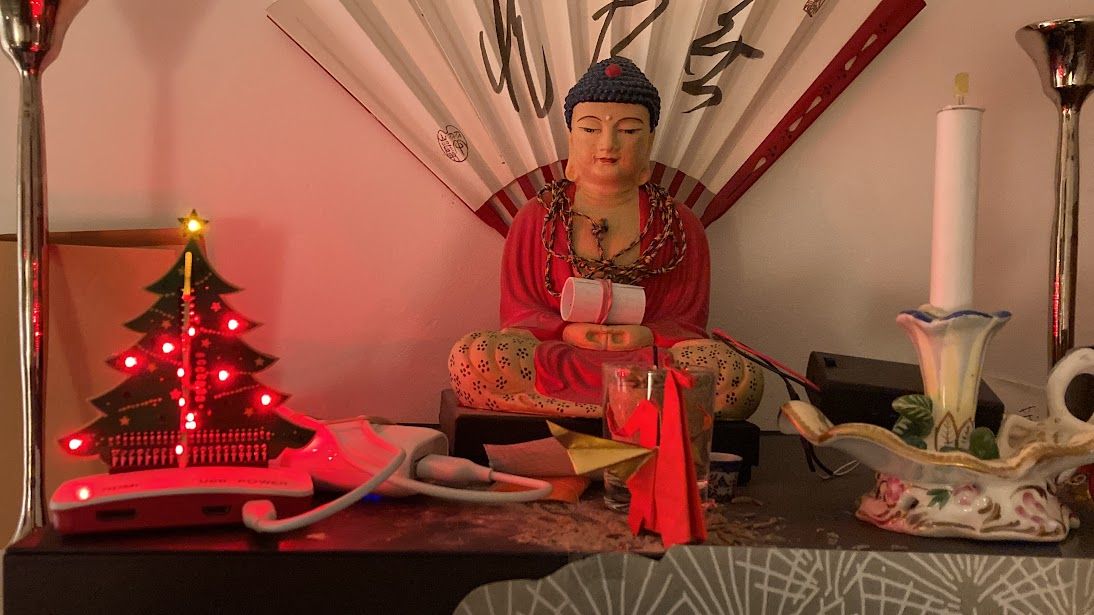
The post below first appeared on a now discontinued blog on December 7, 2013
At the time of writing, I was house sitting in Kirkby Stephen in Cumbria.
Two days ago the weather was wild. A Severe Weather warning had been issued, and structural damage was expected over a huge swathe of Britain. At a critical moment the other morning it was clearly a time to decide to stay indoors, batten down the hatches and sit it out. But I was soon to travel to stay with somebody close to death, my guests were already packing their car to return to Sussex.
The wind was howling, and the rain was horizontal! What to do? This was one of those moments when whichever way one turns, there’s no easy solution. Plans can be changed, appointments rescheduled, but on that wild morning my hand wouldn’t lift the phone to cancel my commitment, and it was also clear my guests intended to travel, no matter what. We were about to put ourselves in serious danger by driving out into this horrendous storm.
Dilemma is defined as being in a state of uncertainty or perplexity, especially when requiring a choice between equally unfavourable options. It’s an uncomfortable place to be, knowing a decision needs to be made, but a decision seems impossible to make. All the while, the roof tiles rattled louder and anxiety levels ran higher! And then the phone rang. After a brief conversation about the weather, the caller said softly, Gran died at 3.30 this morning. And with that piece of the jigsaw in place the picture changed completely, my hand reached for the telephone to cancel my trip, and then I waved off the car bound for Sussex somehow confident that all would be well. And it was.
Being in a state of uncertainty and perplexity, can be an in-the-moment kind of thing as described above, or it can be an ongoing state lasting months or even years. Most often, life require that a step be taken, and then we need to be ready to adjust direction along the way. However, it’s simply not possible to know the complex web of factors that are exerting themselves as we walk our lives. Choosing to pause, to wait a moment – a day or longer can allow for the next step to show itself. As with the uncomfortable, storm ridden morning described above, I do believe we can trust unfolding conditions within the web of our lives to show us the way forward. Which might actually simply be to stay put and ride out ‘the storm’.
Onwards to 2023, may the ‘great earth’ be our witness as we tread lightly on the land.
Thane’s website lists online booksellers stocking this book.
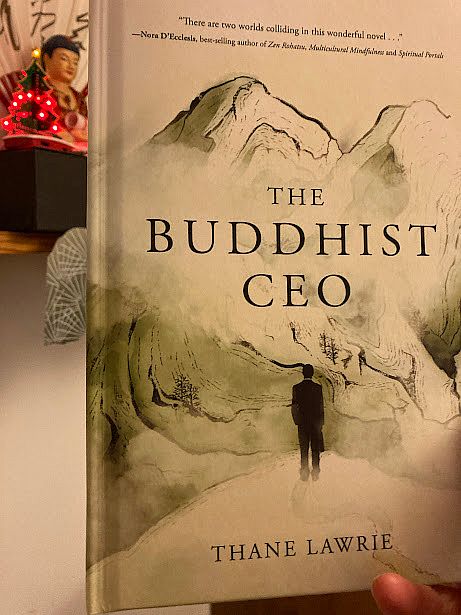
“A prescient read for everybody:
Religious aspirants,
committed business leaders,
and for all who consistently
‘overdo it’ in life.Read slowly as you would a sutra.”
In the past years I’ve offered support to Thane both as a dedicated member of our congregation and lately as he was eventually diagnosed with FND, a life-limiting illness. A hard-won diagnosis, at that, (do follow that link). And then honoured to be asked to read the first draft of his book. Today, in the post, a hardback copy of The Buddhist CEO. It looks and feels so good, it is beside me now. Shall I read it again? I’ll certainly be quoting from it during the upcoming New Year Retreat here. Thanks Thane, you’re a gem.
The above quote is the first part of my recommendation. My vote of confidence in this piece of work. I’ll not go on too much (I’m far, far too excited for Thane and his family atm), enough to copy out the rest of what I wrote.
It is said the Buddhist scriptures (a poetic form of conveying universal truths born of direct experience) were written at ‘death’s door,’ that is, having had one’s faith extremely and severely tested in adversity unimaginable and lived to pass on digested truth. What greater gift could there be?
In the face of a life-limiting illness (FND), Hamish, a dedicated Buddhist practitioner, is forced to change his lifestyle. What truths does he derive from entering the fires of suffering and coming out the other side? Perhaps, for starters, labels have to drop away? No ‘Buddhist’, no CEO.
As I read the first draft, I was somewhat disturbed by how Hamish, the main protagonist, approached Buddhist practice. In the book he is SO dedicated, SO diligent and steadfast with his practice. Clearly, Hamish without the grounding wire of Buddhism would have faltered under the kinds of pressures a CEO faces. (Who would have thought people could be so NASTY at work?) Shocking, deeply so.
And now I see what Hamish shows us is exactly what I’ve been thinking about recently. Firm in purpose and intent, given expression in a soft, compassionate and kind way. And the disturbance? It’s hinted at in my recommendation. Labels drop away, naturally, and one sees and understands from a vastly different perspective. Clearly, there is room for a sequel…to be read slowly as you would a sutra. There is much teaching embedded in this book.
Tom Wharton says it so clearly with his support of this book, along with a number of others, found within the opening pages.
A compelling story reminding me of my own struggles with difficult events in life, and how Buddhism gave me a way to see all of that very differently.
Thomas Wharton, author of Ice Fields.
Thane’s website lists online booksellers stocking this book.

The following was posted on February 8th, 2014 on a now discontinued website. It seems rather connected to the sentiments in the post titled Buddhas Enlightenment – Thoughts on practice. So, here it is.
There is only one thing
To train hard
For this is
True Enlightenment.
Rules for Meditation by Zen Master Dogen
We set great store by being sharp, being focused, being brightly alive. In short, being THERE or, better, HERE. In Zen practice and any other kind of practice for that matter, being one who trains hard is better than being known as a slacker! But what does it mean to train hard, in practice. Are there particular times or circumstances when training hard is what’s asked of us, or is the instruction itself a bit of a red herring? Did the intended meaning get lost in translation?
I had an email from somebody this morning who reflected that with a number of people in our sangha diagnosed with serious medical conditions, and one who had recently died, the call is to train hard while you can. Yes, I can understand that response in a certain kind of way and I also question it too. In my view, meditation, be it formal zazen or throughout-the-day meditation, is essentially an internal movement, a movement to reflect within. How one does that ‘harder’ is less to do with visible effort and more to do with the growth of internal conviction, faith and a steady commitment. That cannot be measured, nor should it be. Not at any time in one’s religious life and certainly not measured by oneself. Faith cannot be measured yet known nonetheless.
When people become sick they quite often become distressed because they are not able to do what they once did. ‘I’m not sitting zazen regularly, I’m not training’. A woman on the phone today said, through her tears, that she was an utter failure because of the thoughts and feelings which were overtaking her at that moment. I advised her to take a walk to her altar, a pilgrimage in itself, and pause there for a few moments. This she did. Her voice changed, becoming softer, and once again she’d returned to touch something deeper in her being. A place of refuge and of faith. At whatever age the mind may not be as strong or as disciplined as we’d like. Emotions can rise up out of nowhere and become overwhelming, as was the case of the woman this morning. As I pointed out to her at the time. All that has happened in your life, all the pain and suffering and disappointments and the seeming failures, point you back to your altar. The non-ferocious way, a term I made up, is simply and softly and continuously returning to the altar of our own heart/mind.
Extra meditation, such as when on formal retreat, invariably points out the very human tendency to hurl ourselves at the edifice of ourselves. On retreat, we come to realize the futility of that approach, and in the process discover by accident the rock-solid-softness within our being.
Crab Apples? They remain hard, even the rotting ones, which apparently doesn’t stop hungry Pigeons eating them, whole! I’ve wondered if there is some teaching around the Pigeon’s behaviour, except that hungry creatures eat anything!
Thanks once again to Mark for sending in photographs. And thanks to the ‘me’ in 2014 who seems to be more insightful than the one who just ended a week-long retreat! Tiredness of body, with a mind all-over-the-place, has me walking up to my altar. There is ALWAYS returning to the altar of our own heart/mind.
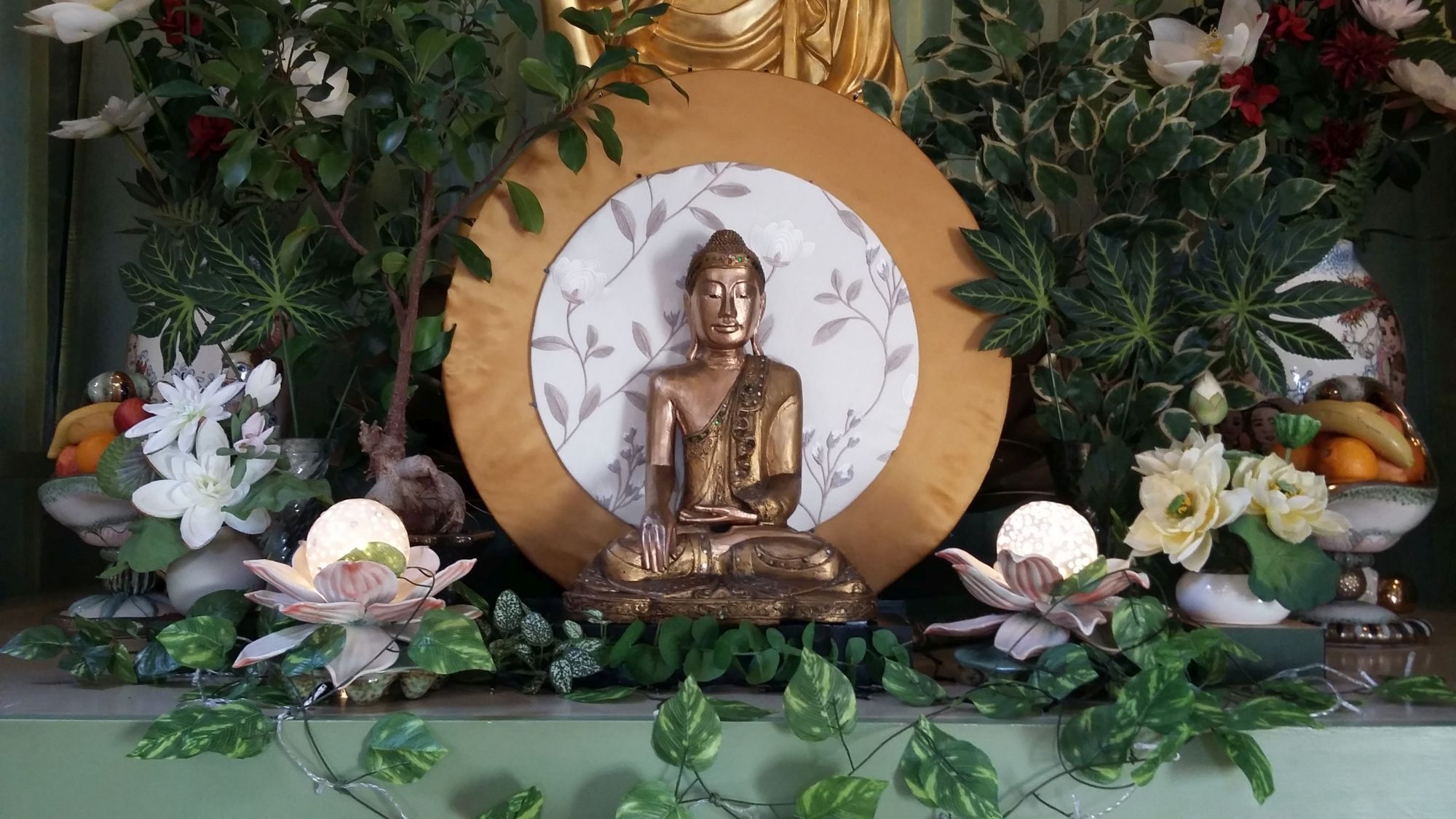 Traditionally, the 8th December is regarded as the date we celebrate the Buddha’s Enlightenment, but let’s not get tight about that, shall we. This is the altar set up for the ceremony in 2018. Nice. With the tips of the Buddhas fingers touching the earth, in so doing asking the earth to witness his resolve. There we go again, the significance of bearing witness.
In certain circumstances, one asks (in one’s mind) for the ‘great earth’ to bear witness. Could be anything, however commonly an element of resolve in the spiritual sphere (less common, for example, a resolve not to eat sugar ever again, but..too much sugar can be life limiting for some, so…. )! You can’t get wider or broader than the great earth as that term (in Buddhism) refers to everything, everywhere..
The Buddha’s resolved not to rise from his place under the Bodhi Tree until he realized Enlightenment. The gist being, he was determined; clear in purpose, firm in intention. Who knows if that was the night, or early morning as it happened, he was enlightened on seeing the morning star. The point is he was firm and clear about what he was doing, sitting still in an ascetic manner not having eaten, much. However.
One can be firm in purpose and intent which can (and should) be given expression in a soft, compassionate and kind way. Traditionally it is said the Buddha was given a bowl of milk porridge to break his fast (now we would say he was ‘being kind to himself’, compassionate but I’d say he was exercising wisdom) by accepting the offering. So in life, as with the Buddha, there is firm in purpose, and soft, kind and wise in implementation.
Back to ‘not eat sugar ever again‘? One might think that is simply a health issue, which it is from a certain perspective. Fundamental to our practice is ceasing, refraining or inhibiting – from habit driven (could be simple avoidance) actions. That is the first of the Three Pure Precepts. There is not a never again in there, just deliberately deciding to not do something one wants to, or could, do. That decision is more powerful than one might imagine, in terms of long term practice.
Isn’t that what we do when we sit down to ‘sit’? That’s to put aside other options, including the fear of sitting and the sometimes almost *intolerable feelings and sensations that arise. Isn’t that what the Buddha did, he could have been down at the river having a wash but no, he decided to just sit.
*here acknowledging that for some it is wisest, very strongly advised, to do ones ‘sitting’ while walking or something else physical and undemanding mentally or emotionally. That too is an expression of clear intention and soft and kindness in implementation.
Happy belated Buddha’s Enlightenment day.
Remembering my dear mother, who died this day, 1994. Later, I’ll pilgrimage down to where she is buried beside my dad in the cemetery here.