Category Archives: Information

In Case of Emergency

Dave, who died recently, was taken to the Emergency Department having collapsed in a supermarket. He had a cell phone on his person and, as good fortune would have it, his lunch date phoned to see why he was late… The ER nurse answered the phone and the lunch date came running, and with her came the information needed to treat him appropriately.

Now. What about if you or I were to be taken off to the ER department in a state of major disrepair. Maybe we are unconscious. Who is our next of kin? Who can make decisions on our behalf? Does this person have any medical allergies? And…just who is this person? There are just a few major pieces of information ER nurses need to know and need to know fast. We can help them, and ourselves, by carrying the information on our person. There is the on-line ICE (In Case of Emergency) service however Ed of Impacted Nurse suggests, urges, people to make themselves a low-tech ‘ICE’ ID card.

It only takes a short time to make up these things and believe me, this low-tech ICEcard is much more likely to be of use to us. Such a small thing, it can make a big difference to the quality and appropriateness of the care you will get.

Today I’ve been preparing to be the temporary priest in charge here at the Berkeley Buddhist Priory. This is earthquake country. One needs to be prepared. So it was with some relief that I read about the 19 Commonly Held Myths about Disasters. Maybe an earthquake does not mean instant death after all. And yes, the house has been retro fitted to withstand earthquakes.
Thanks to Ed, once again, for the information.

There is a Buddhist saying: Hope for the best, Prepare for the worst and do the possible.

Anticipatory fear can cause one to become paralyzed into inaction however being prepared can dissolve that fear.

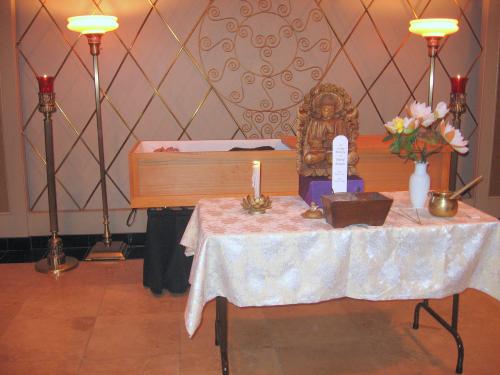
Buddhist Funeral

dave_in_his_coffin_before_cremation.jpg
A Buddhist altar set before the open coffin of David Powers, a long time congregation member within our Order.

Here is an excerpt from the Introduction to a booklet, now out of print, titled The Funeral Ceremony of a Lay Buddhist, copyright 1977, Shasta Abbey.

Buddhist ceremonies are an expression of the “Truth” or the “Buddha Nature” which is within us. The basis of Buddhist practice, which includes the performance of religious ceremonies, is faith in this Buddha Nature. It is we who fill the ceremonies with meaning through our meditation-faith. There is no meaning apart from wholehearted participation. The ceremony is the vehicle of our sincerity, and the form is tailored to meet the needs of the occasion. Teach individual celebrates the ceremony for himself/herself and everyone else. It is not the priest alone who does so; their faith is only the catalyst for others. In celebrating the Buddhist Funeral we know through our meditation, even in the midst of personal grief, that death is an expression of Buddhahood and that there is no beginning and no end to life; zen is eternal life. We cannot understand this with the intellect or emotions – only through our meditation.

The Funeral for David will be at 2.00 pm Pacific Time at Berkeley Buddhist Priory. See also previous posting, Thus Shall Ye Think.
Now I’d better get out from behind this computer and help set up for the funeral.

Engaged Action

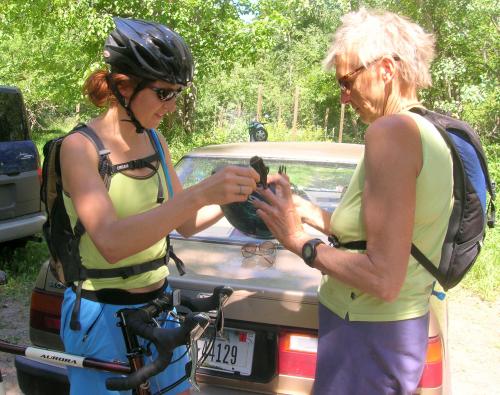
Helpwiththehelmet.jpg
Mother and daughter combo readying for a training ride.

This summer, five cyclists with a shared commitment to creating a sustainable future and extensive wilderness will bike from the southern border of the Yukon Territory in Canada 2,000 miles to Yellowstone National Park in the United States to raise awareness of the Yellowstone to Yukon project (Y2Y).
Quoted from Ride for the Wild – Bearing Witness

I’m drawing attention to this long distance bicycle ride for a number of reasons. Perhaps the main one is I know several of the riders, including the two pictured here, and many of them are practicing Buddhists within our Order. The cyclist’s route takes them through some of the most beautiful country on the planet. My correspondent would know this personally since she grew up in northern Canada where the group start out from in mid August.

While the young woman, the daughter, was here in Whitefish over the week-end we talked about the ride; about safety issues, the reasons for participating, the practicalities and the inevitable vulnerabilities. Six weeks on the road will be a test for all the participants. Several people, including the mum seen above, will join the group at various stages of the trip. I wish them well and will follow their progress.

As far as I am concerned, in terms Buddhist practice, there is just the doing that which is good and following through in a reflective and intelligent fashion. This small band have a mission and a project which they consider good to do. Go for it! Engage fully, and take every safety precaution you can.

Smell The Information

Handy_Home_Book.jpg
I picked up this book at a yard sale yesterday. Found, hand written, on the inside page,
This is a good book. Read and be wise.

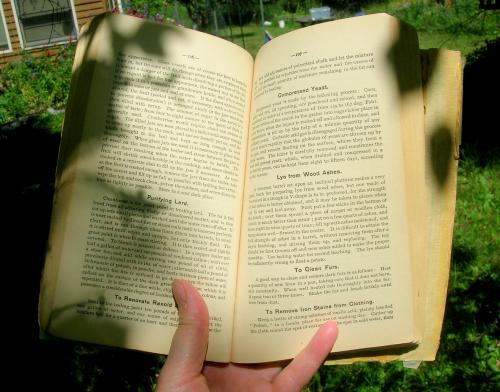
In 1951 the Montreal Star, the most powerful English language paper in Canada, launched its Weekend Magazine supplement The Herald and Weekly Star, with an initial circulation of 900,000. Another hand written note states, Bought Blue suit $40.00 for Easter 1953 at (maybe) Hess Store. and Bought aluminum chairs from club, May 14-53. So this book more than likely is a compilation of information gleaned from the first two years of the magazine’s life. It’s described as An Encyclopedia of Useful Information. There are recipes and instruction for; Making a Bearskin Mat, Bicycle Enamel, Carbolic Soap, To Purify Rancid Lard and my favorite, Sticking Labels on Tin which calls for isinglass dissolved in acetic acid.
inside_of_book.jpg

I’ll remember the sad woman who sold me the book. And I’ll also remember the book’s yellowing crumbling held-together-with-masking-tape pages. Rich human history one can embrace, and smell.

A train is hooting and howling as it passes below the garden on it’s way to Chicago. I see there is an entry First Railways in America. That was a line from Boston to Quincy, Mass., opened on April 17, 1827, And on the next page:

Origin of “Canada”. The word Canada is derived from the Huron-Iroquois Indian word “Kannata,” meaning a collection of huts! (my exclamation point).

Who would have thought that the dissemination of information would travel so far so fast. From down home books like the one described, to the Internet today.

But is it going anywhere?

Innovation – Recognition – Ambition

The O.B.C. web site now has a link to Jade Mountains. This means Jade has joined the ranks of the officially recognized order temples and meditation groups listed within the International section of our website. It is the first weblog maintained by a monk of our Order to be recognized. Maybe it will be the first of many…

For an individual to have a personal website, not to mention a weblog, is a departure from the norm within my organization. So I’m especially grateful for the patience and the huge measures of tolerance extended towards my on-line efforts during the past five years.

Innovating within an organization is a testing business. A few months back I stumbled upon a great book called, The Art of the Start: The Time-Tested, Battle-Hardened Guide for Anyone Starting Anything by Guy Kawasaki. You might think this book is all about how to start a for-profit company, not so. Innovating within for-profit and non profit organizations are equally addressed.

Guy Kawasaki has a blog, How to Change the World and Alltops a news feed site. Jade is listed in the Religion section.

And Zen Master Dogen has a lot to say about getting caught up in fame and gain, he also has a lot to say about giving expression and that need not be driven by ambition.