Category Archives: Teachings

Lamp Unto Oneself

Our phone conversation was coming to a close. She asked, ‘Is there anything you can suggest I do to help myself during the day’? I asked, ‘Well, is there anything that you can think of? There was a long pause and then the answer came. ‘This might sound strange, given all that I’ve spoken about, however everything is well’.

Light_House_at_South_Shields.jpg
Light House, South Shields Northumberland.

“Those who, either now or after I am dead, shall be lamps unto themselves, relying upon themselves only and not relying upon any external help, but holding fast to the truth as their lamp, and seeking their salvation in the truth alone, and shall not look for assistance to any one besides themselves,…”
The Buddha’s Farewell.

Seeking help is not a problem, overly ‘relying’ on or depending upon external help is.

Be a lamp unto yourself…because you are that lamp.

Home is Where your True Heart Is

Two Jade readers, both called Anne, have articles in the Spring edition of our Order’s Journal. The first Anne speaks of the benefits of staying at Throssel outside of retreat times.

And now, after more times spent there when no retreats are running, the (admittedly, self imposed) lines between Throssel and my home have started to blur as the amount of more ‘ordinary’ experiences at the Abbey interweave with my life in my town, and Throssel seems not only my spiritual home–as it always was–but just like where I live day to day–my home.

The other Anne writes about her journey from the onset of Chronic Fatigue Syndrome (ME) through to her life in Mt. Shasta and her association with Shasta Abbey.

Sometimes I just go over to the Abbey grounds, walk down to the stupa and sit. Or I do some little inconsequential errand that takes me over there, so can feel the difference between the silence of living alone in town and the deep quiet of a spiritual community training together. Underneath my surface unrest, a part of me is deeply content with what is, when self is willing to acknowledge it. “Separate,” one of the monks once said, “but not alone.”

Spare a thought for Anne in America who is having a nasty flare up of symptoms at the moment. A thought for her dog Lily too is appreciated.

When Mountains are (Not) Mountains

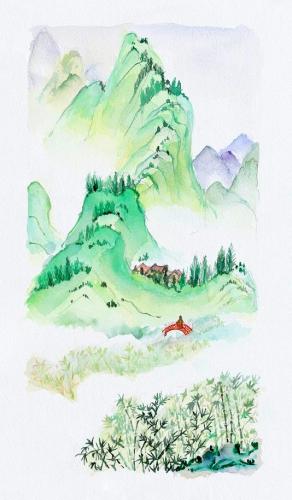
jademountain_watercolour.jpg

…In this place of being, mountains are no longer mountains and rivers are no longer rivers. This is the place in which mountains flow and rivers are as diamond, the place where the life of the river is the mountain, and the expression of the mountain is the river, the place the scriptures describe when they say that the wooden figure sings and the stone maiden dances.
By Rev. Master Daizui McPhillamy, Former Head of The Order of Buddhist Contemplatives.

From an article titled When Mountains are Mountains

More links to O.B.C. Resources. The list of links grows daily.

No Gaps, Constant Choice

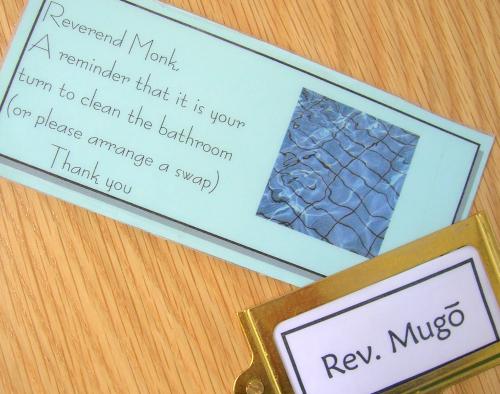
My_turn_to_clean.jpg

On the monastic schedule the time between the end of meditation and morning service and breakfast is Temple Clean-up. As a young monk, under the direction of the Head Novice, one moved briskly from the meditation hall to ones clean-up assignment, there to scrub and polish. There were no gaps between activities, for tea or a chat for example, and no choice of assignment either. Early in the morning cold and hungry I’d sometimes weep, tears splashing into the sink or toilet I was cleaning. More often than not I’d long for the sound of the breakfast bell to bring the comfort of food and the warmth of the dining hall.

As a Senior the external pressure is off. There’s no Head Novice assigning tasks just my fellow seniors slipping the cleaning card behind the name tag on my door. (I just wish I could remember who it is I pass it on to!) Within the confines of the daily schedule one is responsible for planning ones own time. Even writing that makes me smile. Planning! Own time? Even finishing cleaning the bathroom has eluded me today.

9.15 am Cleaning toilet. 9.20 am Toilet half cleaned, remember to make a phone call and send emergency e-mail. 9.40 am Finish cleaning the toilet, hurry to Brunch. 4.15 pm Clean the bathroom sink, floor and ledges. Empty the rubbish bins. Need to do something else, can’t remember what now. The shower will have to wait until I next have one…

If there are tears nowadays they are either an allergic reaction to the cleanser or ones of gratitude. To bend and squat, to rub, scrub and polish are gifts. However the greatest gifts are the gaps, or more accurately the lack of them. Early training, lay or monastic, is learning to move from one activity to another seamlessly, constantly choosing to say Yes when the bell rings. Switching from one thing to another to another to another becomes reflexive action over time. The one who does fades in and out of awareness, as needed. Personal wishes and desires are there but not with such a loud voice, they too have a place.

For me and for those of you who read this the bell rings constantly not just for meals, meditation and work periods. Phone calls-emails-meetings-driving duties-town trip-classes-tea appointments-chats in the lane-walks on the bottom road-chats over the hedge-evening meditation-evening tea-seeking lost belongings-having a nap.

Could this be living Zen?

A Door that Can’t be Closed

Former Muslim radical Shiraz Maher spent his student days campaigning for an Islamic caliphate in which execution for renouncing Islam would be written into the constitution. Now Shiraz is calling for moderation and greater Muslim integration into British life, a stance which has meant he himself is now labelled an apostate by some Muslim radicals, for which the penalty is death. He asks whether such an extreme punishment is really justified by the Qu’ran and the example of the Prophet Muhammad. ‘Could I Stop Being a Muslim?’, BBC Radio 4 FM
Listen on-line or to the repeat Sunday 27th at 5.00 pm GMT

This programme explores the issue of apostasy the formal renunciation of ones religion thus becoming an apostate.

Contrary to Abrahamic dogmas, there is no concept of an apostate in Hinduism or Buddhism, as everyone is accepted as one and the same. Converts to other religions from Hinduism or Buddhism are accepted in these communities, as there is no Hindu or Buddhist procedure that defines apostasy.
– Wikipedia.

Thank you to my monastic walking companion for bringing the concept of apostasy to my attention. This is a new word for me but not a new concept, thankfully not one we have in Buddhism. I’ll listen to the recording of the above programme when I return to the monastery tomorrow.