One of the senior monks of our Order can be found answering questions on camera as part of the Clear Vision schools project, Ask a Buddhist. While I have not seen the videos personally, since I’m on a slow dial-up connection, Angie who comments regularly here has. She said, What a wonderful site! It is lovely to see and hear our Reverend – it is definitely worth putting on your blog. Thank you.
Here are the questions the children asked: Are you Enlightened? If not, how do you know? How would you know if you were?
A question on why Buddhist meditate and there is an answer to the following query: Buddhism goes on about suffering. Don’t you find it pessimistic and depressing? Good questions, I look forward to seeing and hearing the answers. As I understand it this is not a studio production job and the answers were caught on the fly, so to speak, with little or no opportunity for preparation.
For anybody with children or teachers giving instruction on Buddhism, The Clear Vision Trust is a wonderful resource.
I’m sorry if you are, like me, on a slow internet connection and not able to view these videos.
On the first Sunday of each month at Throssel there is generally a large festival ceremony. Today we honoured the Buddha of Healing. Very many people filled the hall, some here for the day, others residents and others just visiting for the week-end retreat.
From the Offertory for The Festival of Bhaisajyaguru Tathagata
Wholeheartedly do we recite these scriptures and make these offerings in honour of Bhaisajyaguru, the Buddha of Healing who sits radiantly in the pure land of this moment.
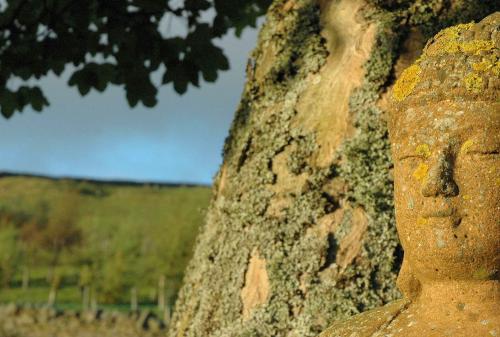
On the way to the evening meal, the Medicine Meal as we call it, a visiting fellow monastic and I took many pictures of the statue in the lane. As we continued on to the meal we pondered, Isn’t that the Buddha of Healing? I questioned. Yes, I think it is. came the reply. Ah, perfect for to-days posting. I thought.
Many times a day the monks pass this statue going too and fro between buildings. We pause. Turn and bow. Then turn again and walk on about our business. In the evening glow of autumn light the statue does indeed sit radiantly, in the pure land of this moment.
Even though we are wearing these formal robes we can still know True Freedom.
Paraphrased from Not Always So, by Shunryu Suzuki Roshi.
While at San Francisco Zen Centre last week I had the great good fortune to offer incense and make bows to the memory of Shunryn Suzuki at his memorial shrine. He wrote Zen Mind Beginners Mind a book which brought many to Zen practice, including me. The opportunity to express gratitude was a gift in itself.
Shunyata Karuna Garbham
Emptiness is in essence Compassion.
Nagarjuna, Fourteenth Ancestor after Shakyamuni Buddha in our Transmission Line
Sit still and then get up and be Compassion.
Note: Garbham translates as Womb or Embryo. The use of ‘in essence’ above helps to make the point that Shunyata is not an vacuity or ‘negative emptiness’. As my Master would say It is the fullest emptiness you will ever know.
Many thanks to the Reverend who pointed me to this teaching.
The following is from an article titled, The Buddhist’s Responsibility to Animals by Rev. Master Jiyu-Kennett. The article first appeared in the Journal of the Zen Mission Society, August 1970 and was later reproduced in the Memorial Issue of the Journal of the Order of Buddhist Contemplatives Winter 1996/Spring 1997. Copyright O.B.C. 1997.
I have often thought that if some of the rich people who give so happily to animal welfare associations could be persuaded to give a little of their money to advertising in newspapers descriptions of specific animals who, for lack of homes, were to be destroyed that very day, they might do more good in solving the unwanted animals problem than in buying new humane killers for the societies to use. I have yet to find any person who could resist the appeal of a fellow creature about to face death. As the Buddhist teaching in the oldest of Scriptures says, ‘All men fear punishment, all men fear death.’ To know that a fellow creature faces that very situation within a few hours might bring the truth of the plight of animals home more clearly than any amount of beautiful society buildings could. After all, a good building gives the impression that the animals are being well cared for and need no assistance. A prominent picture in a newspaper, however, with the caption, ‘To Die Today’, would be much more effective in making the public realize its responsibilities and obligations.
I know of a woman who read this article and took this advice to heart. She regularly publishes photographs of dogs in the local newspaper that are about to be killed if they are not adopted. She says all the animals are adopted. All of them!
Practice Within The Order of Buddhist Contemplatives