Category Archives: Overcome Difficulties

Going Beyond Vengeance – A Story

This story draws on different versions of the tale, particularly from the book, Beyond the Pale of Vengeance, translated by Rev Jisho Perry (a monk of our Order) and Kimiko Vaga, and published in the USA by Shasta Abbey Press. A short version can also be found as ‘The Tunnel’ in Zen Flesh Zen Bones, published by Penguin / Tuttle.
Beyond the Pale of Vengeance

Ichikuro, the son of a samurai warrior, journeyed to Edo in Japan to become a samurai at the service of Lord Saburobei. But he became involved with the official’s wife. When the affair was discovered, though he didn’t intend to, he killed his master in self-defence. He was deeply ashamed. And fearful of the consequences, Ichikuro and the master’s wife took flight.
They took to thieving, and soon became deadly bandits. But his partner in crime grew so greedy that Ichikuro became completely sickened by everything. In the end he left and journeyed to a neighbouring province, reduced to wandering, aimless and distraught. Then one day, he came upon a Buddhist temple. He confessed his crimes and talked of giving himself up. But the priest there saw that Ichikuro was genuinely remorseful and wished to make amends. He knew that he would certainly be executed. He advised Ichikuro not to throw away his life, but to dedicate it to the benefit of all beings. Thus Ichikuro became a monk with the name Ryokai, and he went on pilgrimage to atone for his past.
And so Ichikuro, now Ryokai, resolved to help travellers in whatever way he could find. But his deeds felt completely trivial alongside the enormity of what he had done. The more he helped, the heavier his burden seemed to become. Then one day he came across a group of anguished people standing by a fragile walkway. Their friend had just slipped and fallen into a deep gorge. He was told the walkway was there because it was impossible to build a road through such sheer mountains. Many travellers had been injured or had died.
At once Ryokai realised the great deed he inwardly was being called to undertake. He resolved there and then to dig out a tunnel through the mountains to make the route safe.
Being a Buddhist monk, Ryokai begged for food alms by day and spent his nights digging the tunnel. The local villagers were convinced he was mad in attempting such an impossible task, and no-one offered to help him. So he worked on alone. And much time went by before, gradually, the villagers’ scorn began to turn to sympathy. They started to help him. And after 20 years, the tunnel was more than 2,000 feet long.
But before the tunnel was completed, the son of the official he had killed, found out where Ryokai was. By now he was himself a skilful swordsman and warrior, and he vowed to kill Ryokai in revenge, to defend his family’s honour. As the son approached, enraged, the villagers, and by now stonemasons who had joined them, realised what was about to happen. They surrounded Ryokai. They pleaded with the son to let Ryokai live until the tunnel was completed. They promised him he could then do what he wanted.
After much arguing, the son very reluctantly agreed, and he just waited. Time went by. Ryokai kept on digging. The son grew impatient of just waiting. To hasten the day he too began to dig, as he realised Ryokai would not try to escape. So the two enemies sat side by side, hammering and digging. Months and months went by, and the son continued to work alongside Ryokai. Despite himself, he came, at times, to respect the old monk’s intention, determination, and patient effort.
Then, at last, the tunnel was completed and people and opened up a safe route for travellers. ‘Now kill me’, said Ryokai. ‘My work is done. My great prayer has been answered. If you wait until tomorrow the villagers will surely stop you. Please kill me now’.
But the son could only sit motionless in front of Ryokai. Seeing the old monk infused with such inner calm and joy made the idea of killing him inconceivable. Crawling towards Ryokai, he took his hands into his own, all thoughts of revenge forgotten – how could he possibly kill someone from whom he had learnt so very much? Tears streamed down his cheeks.
(This text adapted by Paul Taylor (Lancaster) is from the book Beyond the Pale of Vengence, published in USA by a monk of our order.)

*The service included inviting representatives of different faith communities, each to read or tell a story from their own faith tradition. The guidance was that the stories needed to last no more than five minutes each – there were four stories. As part of the service the congregation was divided into four groups and each group went on a journey round the church to hear each story in turn. This was in keeping with the national theme for Holocaust week, of ‘Journeys’.

To Know Her Was to Love Her

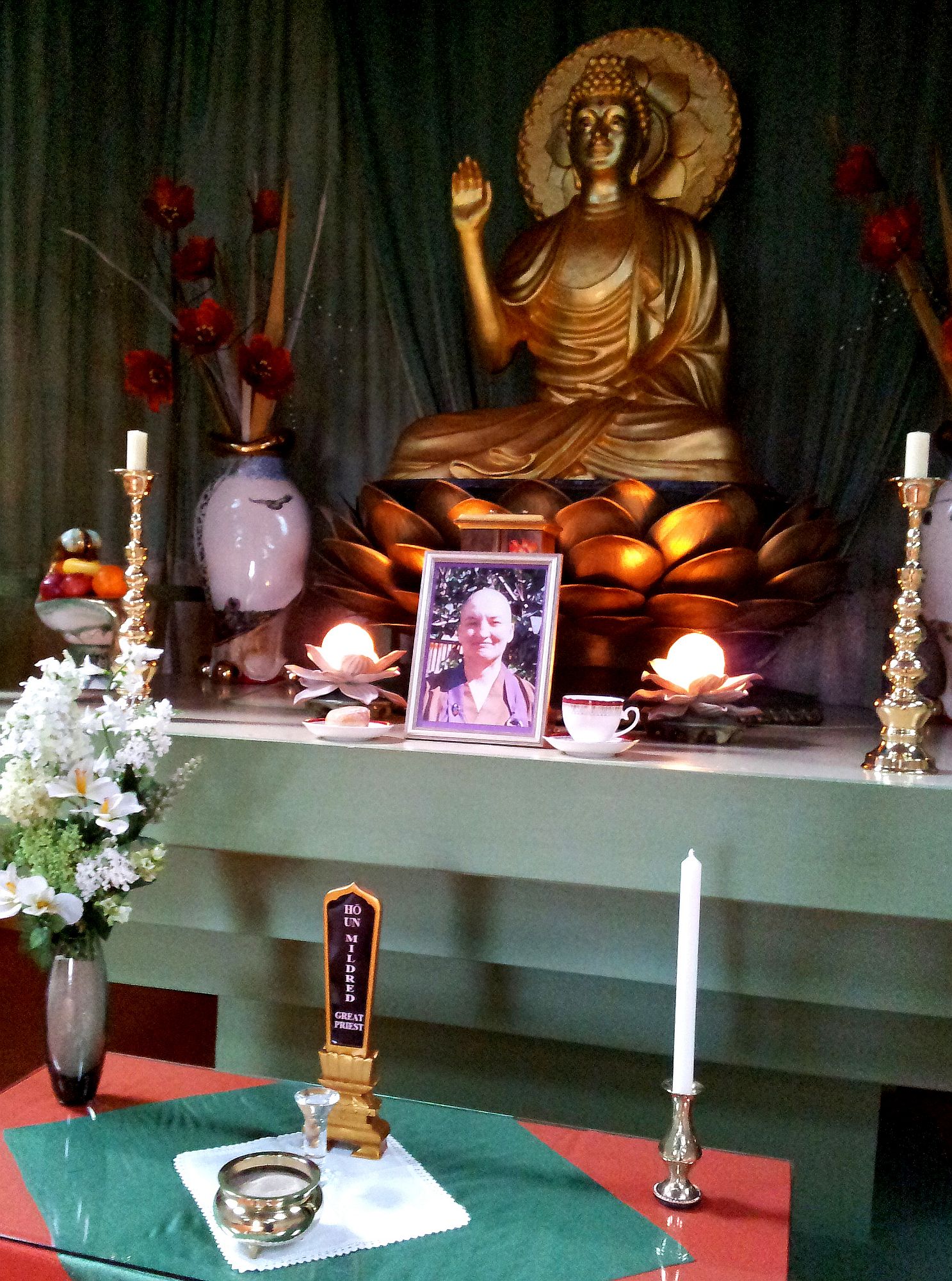
Memorial Altar for the late Rev. Mildred, Throssel Hole Buddhist Abbey.

This afternoon a number of us gathered around the kitchen table at Throssel drinking tea and reminiscing about the late Reverend Mildred. Earlier the community had gathered in the ceremony hall for a ceremony in her memory it being ten years today since she died. She and I lived at the Reading Buddhist Priory in the early 1990’s and several people who read Jade will remember that time. She was a novice monk and it was my job as senior (and Abbot) to train her to be what’s termed in our tradition the Chief Junior of the temple. The CJ’s job is to make sure everything runs smoothly in the temple and instructs visitors and guests. Perhaps those of you who were around then would like to leave a comment to this post to add to the reminiscing.

One regular member of the priory once said she didn’t remember much, if anything, of the teaching I gave during Dharma talks. My heart sank. Then she followed up by saying how much she learnt from seeing how I dealt with sometimes tricky situations that came up between the Reverend and I. She assured me the learning was good. Thankfully! Living in such close quarters it was essential to deal with upsets as they arose and kindly too.

One time when I was traveling to visit meditation groups in the South, I’d do a three day tour, I picked up a mug for Rev. Mildred. I was fairly pleased with it and I think she appreciated it too. On the mug was written, To know me is to love me. I remember Rev. Mildred with huge gratitude for our time together, testing as it was for both of us at times.

Deepest Wisdom of The Heart

When one with deepest wisdom
of the heart
that is beyond
discriminative thought,
The Holy Lord, great
Kanzeon Bosatsu,
Knew that the skhandas five
were, as they are,
in their self-nature,
void, unstained and pure.

For those not familiar with them these words come at the beginning of The Scripture of Great Wisdom, or Heart Sutra. There are many other translations of the S.G.W. however the above quote comes from the translation we use in the order. It’s Kanzeon Bosatsu, who is teaching in this scripture and from a depth of wisdom beyond discriminative thought.

The Five Skhandas are a traditional Buddhist way of analysing the self or ego by splitting it into five components parts namely form, sensation, thought, activity and consciousness. These five components make up self. It is very easy to misunderstand this scripture as saying there is no self, no individual persons, no sentient beings, which just doesn’t mesh with everyday experience. What’s being pointed out is that, on the deepest level of discourse, there is no SEPARATE self. Which doesn’t make sense in terms of ordinary everyday thinking either! Kanzeon, talking from the deepest wisdom of the heart, knows that not only ‘selves’ are not separate it follows that the senses are not separate from their objects either. No ear separate from sound etc. no taste separate from tongue. This too doesn’t mesh with experience!  If the Scripture of Great Wisdom is not understood in the wisdom department life would get seriously strange. Obviously.

It is not that unusual for people to have a deep insight into the way things are at a relatively early age. Having a flash of insight is not the whole picture however, more just a snapshot however profound, and if clung to can cause people to become off-kilter in their lives. That’s especially if there is fear involved and/or no context, religious or otherwise, to set such an insight within. In the last few lines of this scripture there is a clear instruction to keep moving on continuously from what’s known and understood. I can’t count how many times I heard my teacher Rev. Master Jiyu-Kennett say this, to me and to others.

O Buddha, going, going, going on beyond’

Always becoming Buddha.

So, while keeping this ‘going on’ instruction in mind everyday there is the encountering, appreciating and acting (or not acting) within the world of appearances, of separateness. And accepting and loving that.

Kanzeons deep wisdom is born out of great compassion and great love.

Merit Walk In The Wind

Two hours hard walking
One hour up
One hour back.

Thinking of a
Sangha Friend
in Canada.

Another health adventure
not knowing more than
the next breath.

Breath just
keeps on
breathing – you.

While I walked today my thoughts were very much turned towards a long time sangha friend who has recently been diagnosed with cancer. Hard and heart-breaking.