Direct Encounter – Direct Response

On Monday I drove to Newcastle Airport to pick up a monk returning from America. Walking through the wide open space in front of the check-in counters a man stopped me and started talking. He hardly drew breath. He was giving a pitch. Raising money for Shelter, the charity for the homeless. I had the option to cut him off and make a run for the toilets. Which is where I needed to be! But I didn’t. I listened. For no reason, I continued to listen knowing I’d not be donating. As he went on the content was fading into the background of my awareness as my admiration grew for this chap. Eventually I drew breath. He thought I was about to exit. Yes, I know you are busy. Just need to tell you a bit more… I responded thoughtfully, Well to be honest I’m just so impressed at your ability to keep on talking! That’s no small skill and what you are doing here must be really hard. Probably demoralising too. Said just what came to mind. Soon afterwords with his words Just five pounds… and my, sorry I’m a Buddhist monastic and don’t receive a wage (excuse?) echoing in my mind, I beat a retreated.

I love airports. Love all that open space, and the shops too. Since it was early and I’d not eaten yet, I had a treat at Starbucks. A muffin and small drink for breakfast. Now alert; watching out for flight arrivals, watching shoals of passengers flooding into the concourse with their luggage. All the while looking out for my arriving passenger. Enjoying my breakfast, while thinking about that five pounds and contemplating going back to offer it. I’ve that much with me and a bit more.

Out the corner of my eye as I finish breakfast I spot the man just feet away from me. He’s talking. I wait until he stops. Can you take change for a ten pound note? I call to him. Turns out he can’t take cash. Too bad. More ensued about donating on-line but he seems to be abandoning his pitch… Engaging me in conversation. Taking an interest. Is it like spiritual what you do in the monastery? We talk and in the end I gave him the address of the Throssel web site and this blog written on the paper bag the muffin came in. I told him, his name was/is Chris, that if there is one thing to come out of our conversation it’s to get some cards printed. I’m always writing address on scrappy bits of paper. But cards seems…well pretentious somehow.

It’s the subtexts I’m particularly interested in. The subtext of this encounter and encounters generally. And the non stereotypical response, mine and his. There’s the words people say. That’s one thing. But there is much much more, to any encounter, who ever is talking and who ever is listening. What is interesting to me, and the challenge, is to take in the whole picture while at the same time allowing the parts to come and go in awareness. That’s to stay with the detail long enough to be able to respond to the whole. To respond past ones preconceived ideas and prejudices. This can happen at work, at the dinner table, in the street even when reading this blog. Nothing special really.

Hum! And when I really think about it I’m really relying on you reading past the text. Not using that little old trick of reading between the lines which really means adding in ones opinions and preconceived ideas. No not that. Please! Reading past the text is to encounter yourself while you read, and to encounter the writer too. Directly.

Learning From Experience

I was driving a friend of my wife’s to a hospital fifty miles away. It was a thunder, lightning and rain Summer’s night. At one point I had to almost go off road to get around a large tree that had blown down on to the road. After a few more miles I suddenly saw two cows next to my window and then saw a bunch of them ahead of me. I slammed on the brakes and to my horror we plowed right into a group of them, a dozen or so filled the road way. I felt an impact and the hood of my truck folded up into a tent shape and all I could see was a calf walking toward the edge of the road dragging a broken leg.

Contemplative Spaces post: Driving

Contemplative Spaces
, with ace content, is a relative new blog written by a chap I know through my work within the OBC. He lives in rural Washington State with his wife. From time to time Helmut has agreed to make a guest appearance here on Jade.

First Post

Dear Reverend Master Mugo,

You have asked me to consider writing a regular contribution to your Jade Mountains. With some nervousness, and as usually seems to be the way with these situations, something is saying yes, ok; and then I’m trying to work out what it is I’ve said yes to, and if it is good to do then why is it, and how can it work for us? I know you better than to ask exactly what it is you were thinking of, so here is my go at what might work for me.

The first thing to say is that this clearly can’t just be an opportunity for me to tell people who read your site what I think about things. If I was going to do that then I’d be setting up my own site and doing it directly; and I’m not. So if not that, then what?

Well, I started to wonder what you think might be missing from Jade Mountains as it currently stands. And I came up with a couple of possibilities.

The first is that you’re a monk – and a very well established one at that: however understated about it you may be, you are a Zen Master. It follows that your life and experience may not express many aspects of what Buddhist training might be like for people who aren’t monks – although your honesty and humanity in what you write go a long way to showing that this difference isn’t as great as we sometimes might like to think.

Secondly, and perhaps more deeply, for me a great deal that is important in our training is about the dynamic between ‘teachers’ and those of us hoping to learn something and receive support in our practice. Zen in particular seems to be so much about someone asking a question and an answer coming back – often not the answer we were looking or hoping for but an answer that cuts to the core of what is being asked. Quite a few of your postings reflect this with you sharing some of the letters people have sent you and your responses. And wouldn’t it be interesting to see if some of the dynamic of how this continues over time could be illustrated by me sharing my thoughts, worries and questions with you, and through you with your readers?

So these thoughts led me to wonder – how about me writing to you on a regular basis through your site? Often it could be that no actual response is needed from you – there is something about the act of opening up and asking and sharing that frequently just by itself resolves the question.

When I look at your original request for me to contribute in this light then I can see a possibility of me writing about training and how that impacts everyday life without it being me expressing my opinions, or trying to inform or teach. It would really just be a continuation and development of what we have been doing for years.

You have been around and deeply involved in all of the nearly 20 years I’ve been training in this practice – from being the scary visiting monk who used to come to our home when we were running the London Meditation Group; through the years when you lived in the mobile home in our yard here on the farm; and with our ever evolving relationship with the OBC and the Lay Ministry. This seems like another opportunity opening up – perhaps unorthodox, but I suppose you often seem to find some particular energy in new approaches to things.

As ever I am left wondering maybe it will work? maybe it won’t? and cutting through all this nervousness echoes one of the hallmarks of your particular teaching – let’s get up and try it and maybe we’ll find out.

Does any of this make sense? Is it the sort of thing you were thinking of?

in gassho,

Andrew

Let it Float

keys_of_Royal_Signet.jpg

I am writing this on a 1942 Royal Signet portable typewriter. It has no exclamation point and has only upper case letters. It demands a firm stroke; and hesitation producing only a faint impression of your intentions. It is sturdy and obviously built before and notion of planned obsolescence. It sounds and smells like history.

My father bought this typewriter the year that it was manufactured, though I only remember it in brief moments of clarity in an otherwise vague childhood during the suburban 50’s. The machine recently came to me from the far reaches of a storage unit that my sister was cleaning as she prepared to move to another state. I believe that it has been about forty years since I
last pounded these keys.

Along with the typewriter, many boxes of photos and papers also showed up, including little love notes typed on this machine and left for my mother as my father headed off to the still mill in the Chicago of the 40’s.

The boxes also proved to contain a dissembled chronology of both sides of my family history. Folders full of trivia hid notes of clarifying significant events. Photos of unknown people having fun at a picnic provoked a visceral discomfort. Memories and narratives of my life began to stand on their heads and morph in endless iteration.

This disruption of the story of self continues. There’s a liquefaction of the ground on which I stand, like what happens to silty soil during an earthquake. This all sounds rather dramatic, but there really are only moments like that. Mostly it’s been about noticing the shifts in perspective and quietly waiting to see what’s going to show up next. Not forcing myself to dig deeper, not turning away from what’s there.

Every so often I come across a picture of myself at a younger time; peering into the picture like I’m trying to see through to the truth or gazing out-of-frame trying to look cool, or both. And I see now how much I missed wearing such earnest blinders. At the same time I notice that it’s all being offered again and again and that more of whatever IT is can be seen when viewed through the tatters of what I last held to be the real story.

In the midst of this unfolding, I especially appreciate this 1942 Royal Signet portable typewriter for its helpful qualities: that it requires such sensate – and anchoring – operation and for its ability to have waited for 40 years to again be of service.

About Andrew

Andrew Taylor-Browne | Read

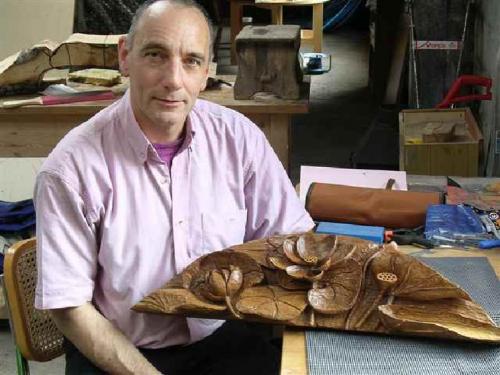
Andrew_and_carving.jpg
Andrew with carving

Following a variety of related careers as an academic, a management consultant and a director of an international law firm, Andrew now spends most of his time tending the various animals, gardens, wildlife, woodland and numerous visitors at his and Julie’s 65 acre farm in Cornwall.

He has been practicing in the tradition of the OBC for nearly 20 years and has been a Lay Minister with the Order for 16 years.

He has a particular enthusiasm for the issues of sustainable living, deep ecology and all things to do with wood, trees and woodland.